Showing posts with label historical-analysis. Show all posts

February 12, 2021

Assorted Darwin Day Content


For this year's Darwin Day post, I will highlight a number of items I have recently run across on Twitter. Some of these have been retweeted on the Orthogonal Research and Education Lab Twitter feed, other materials are related to discussions in our research group meetings.

To start things off, I will draw your attention to a new special issue of Royal Society of London B called "Basal cognition: multicellularity, neurons and the cognitive lens" that is worth checking out. The term "basal" refers to evolutionary origins in the context of phylogeny (the tree of life). 


The new paper on elementary nervous systems in Royal Society B (click to enlarge, figure from paper). COURTESY: Detlev Arendt.

A pointer to the Darwin Online repository.

In terms of old drawings and other archival materials, check out the Darwin Online project. This is a nice repository of Darwin-related historical and scientific works. This resource contains books, personal correspondence, and published materials. Speaking of history, let's turn to the deep history of life.....

A billion years of continental drift as an animated gif. Click to enlarge.

This next feature is a new paper on a billion years of plate tectonic dynamics: "Extending full-plate tectonic models into deep time: Linking the Neoproterozoic and the Phanerozoic" by Mike Tetley and colleagues. Now published in Earth Science Reviews, it is something we recently discussed in the weekly DevoWorm group meeting.

Following up on the DevoWorm discussion, which was about mapping the continental drift animation to the most basal branches of the tree of life, is an attempt to map Mammalian phylogeny [1] to continental drift over the past 225 million years. This was created by Carlos E. Alvarez. The numbers on the maps (top) correspond to the numbered clades (subtrees - bottom). This topic deserves a deeper dive into the latest Phylogeography research [2], which may be the subject of a future blog spot.

An attempt at matching up the tree of life with continental drift (click to enlarge). COURTESY: Carlos E. Alvarez

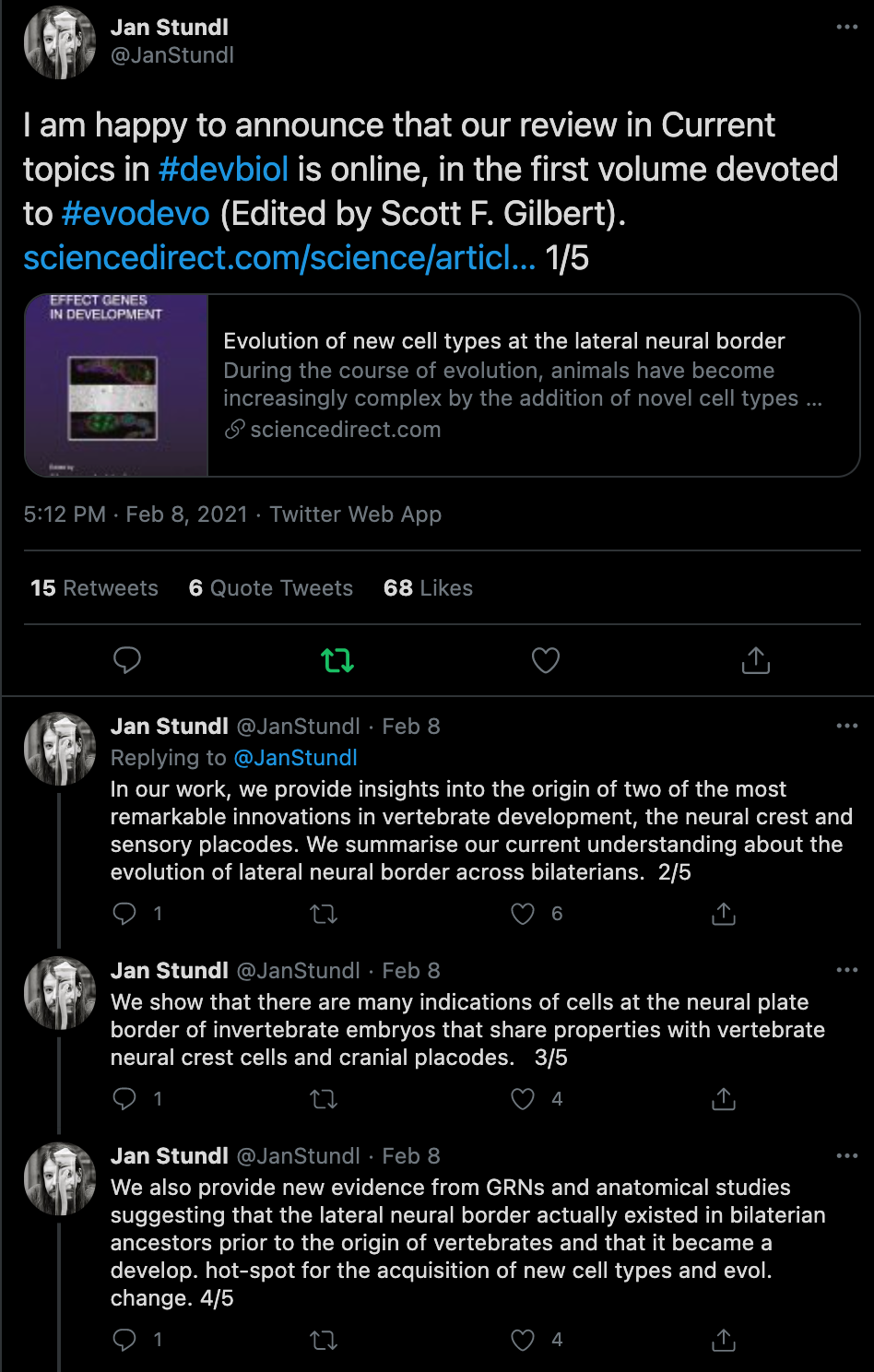
The next feature is a new paper on evolution of development (evo-devo) in nervous system anatomy called "Evolution of new cell types at the lateral neural border", now published in Current Topics in Developmental Biology. This study even uses converging evidence from genetic regulatory networks and anatomy to demonstrate common mechanisms shared between invertebrates and vertebrates.

A new paper on the evolution of new neuronal cell types (click to enlarge). COURTESY: Jan Stundl (Caltech).

Not only is this Darwin Day, but also the 50th anniversary of a Nature paper by Kimura and Ohta [3] on the Neutral Theory of Molecular Evolution. Neutral Theory postulates that most biological variation is expressed in selectively neutral genes, and so is random in nature [4]. This stands in opposition to the selectionist perspective of evolutionary change [5, 6].


Fully-tweetable neutral theory of evolution. COURTESY: Andrew J. Crawford.

Finally, and returning to neuroevolution, there are several items of interest from the laboratory of Cassandra Extavour. The first is a talk at the Society of Integrative and Comparative Biology meeting on the evo-devo-eco-neuro-biology of Drosophila learning and memory. For more evo-devo work from Dr. Extavour's lab, check out this recent work (with open data) on insect size and shape [7, 8].

Original artwork from SICB Twitter Account, commentary from Ken A. Field.

Hand-drawn notes on the SICB plenary talk. COURTESY: Dr. Ajna Rivera.

NOTES:

[1] Foley N.M., Springer M.S. and Teeling E.C. (2016). Mammal madness: is the mammal tree of life not yet resolved? Philosophical Transactions of the Royal Society B, 37120150140. doi:10.1098/ rstb.2015.0140.

[2] Avise, J.C. (2000). Phylogeography: the history and formation of species. Harvard University Press, Cambridge, MA.

[3] Kimura, M. and Ohta, T. (1971). Protein Polymorphism as a Phase of Molecular Evolution. Nature, 229, 467–469.

[4] Kimura, M. (1983). The Neutral Theory of Molecular Evolution. Cambridge University Press, Cambridge, UK.

[5] Nei, M. (2005). Selectionism and Neutralism in Molecular Evolution. Molecular Biology and Evolution, 22(12), 2318–2342. doi:10.1093/molbev/msi242.

[6] There are other critiques of selectionism from other perspectives. Here is one in the area of brain function: Fernando, C., Szathmary, E., and Husbands, P. (2012). Selectionist and Evolutionary Approaches to Brain Function: A Critical Appraisal. Frontiers in Computational Neuroscience, 6, 24. doi:10.3389/ fncom.2012.00024.

[7] Church, S.H., Donoughe, S., de Medeiros, B.A.S., and Extavour, C.G. (2019). Insect egg size and shape evolve with ecology but not developmental rate. Nature, 571, 58–62.

[8] Church, S.H., Donoughe, S., de Medeiros, B.A.S., and Extavour, C.G. (2019). A dataset of egg size and shape from more than 6,700 insect species. Scientific Data, 6, 104.

October 25, 2019

OAWeek: share your own case study!

This post is part of a series published over the course of OAWeek 2019.


Do you use, share, or have an opinion about open data? The Data Reuse Initiative would like to hear from you! In honor of OAWeek 2019, we are looking for personal and research group testimonials on how you share or otherwise practice open data. Submit at your leisure (there is no deadline), but we would like to hear from you!

RULES:
* submit a testimonial (under 200 words) by submitting a pull request to our Github repository or submit to this Google Form.

* if you choose to submit an image (screenshot, diagram, or cartoon), please issue a pull request on Github.

* if you cannot access either of the links, or need help with your submission, please [contact us](mailto:balicea@openworm.org).

October 24, 2019

OA Week: Digital Badges on Open Data

This post is part of a series published over the course of OAWeek 2019. Today's post will preview a series of digital badges related to Data Reuse. These badges were designed in conjunction with the new Data Reuse Initiative.


Overview of Data Reusability I. Click to enlarge.

The first digital badge (Data Reusability I) provides the learner with some practical skills in data sharing. The practical examples are mostly biology-oriented, but is useful for learners from a wide range of fields. Activities include work with a selected article from the journal Genome Biology, posting a sample data set to Figshare, and working with data sets published on the Dryad repository. While these activities provide just a taste of the work involved in sharing data, it nonetheless imparts some key skills in interacting with and publishing data in an open fashion. 


Overview of Data Reusability II. Click to enlarge.

The second digital badge (Data Reusability II) provides a tutorial that reviews public data sharing competencies in more depth. For this set of exercises, we have used the Mozilla Data Sharing Planning Template as a model for best practices community standards. Earners of this badge will develop competencies in metadata creation, data cleaning/processing, documenting data set provenance, assigning credit for the published work, and enabling easy and reproducible reuse of the data set. Check them out!

October 22, 2019

OA Week: History of Open Access

This post is part of a series published over the course of OAWeek 2019.

Timeline of scientific output from [1]. Click to enlarge.

This post will walk us through the History of Open Access (with a focus on Open Science) infographic mentioned in our inaugural blog post for this series. Randall Munroe [1] has previously summarized the progression of open science as a function of the scope of scientific output. The events and milestones for the featured historical overview were confirmed by internet search and synthesized from a survey of various tools and publications common in the field. This post characterizes the historical eras according to a developmental biology theme: from the embryo to developmental plasticity to an adult stage of life-history.

History of Open Access (1942-present), color-coded by historical era. Yellow: early, blue: transitional, green: contemporary. Click to enlarge. For a citable version and an alternate display type, please see [2].

1942-1999: Embryonic Ideas and Tools (early). Click to enlarge.


In the early period, there was an emergence of tools, ideas, and attempts to synthesize independent efforts. Early efforts such as the World Data System, MedLine, and Project Gutenberg served as inspiration for later efforts (particularly the development of MedLine into PubMed). Tools such as digital preprints (arXiv) and the internet (HTML, XML) served to provide the infrastructure of open science. Even tools such as Cyc (extraction of scientific rules from data) served to enable greater openness in the practice of science. The end of this era is marked by "Exploring the Development of the Independent, Electronic Scholarly Journal", a survey of open access journals in what coincides with the early internet era.


2000-2008: Institutional Plasticity (transitional). Click to enlarge.


The transitional period (or institutional plasticity) was a time for creating many of the institutions and established norms of the open science community. Many foundational ideas were either established (Creative Commons, digital object identifiers) or came to fruition (Human Genome Project) during this period. It is also of note that at least four declarations of practice were published during this period.


2009-present: A Juvenile No More! (contemporary). Click to enlarge.


The contemporary period has been defined by even more sophisticated tools (Altmetrics), quasi-historical summaries of past work for future development (Reinventing Discovery, The Future of OA), and the discussion of institutional standards at a greater level of specialization (FAIR Principles). This era is also marked by the use of open science to practice collaborative open science (Polymath Project), putting all of the pieces developed in previous eras into place.

NOTES:
[1] Munroe, R. (2013). The Rise of Open Access. Science, 342(6154), 58-59. doi:10.1126/science. 342.6154.58

[2] Alicea, B. (2019). History of Open Access Infographic. Figshare, doi:10.6084/m9.figshare. 9975713

October 21, 2019

Open Access Week 2019: Introduction

Welcome to OAWeek 2019! This year's features are being published in conjunction with the Orthogonal Research and Education Laboratory, the eLife Ambassadors program, and the associated Data Reuse Initiative.

The first feature for this year is an infographic called the History of Open Access [1]. Our history begins in 1943 with some Philosophy of Science [2], and proceeds through key innovations, publications, and institutions the span the late 20th and early 21st centuries. Below is a preview of the infographic, and will be discussed in more detail on Tuesday the 22nd.

History of Open Access infographic (Omega version).

The second feature is a series of digital badges (microcredentials) on Open Data practice [3]. The first badge in the series walks the learner through several lessons on how to identify, locate, and work with open datasets. The second badge walks the learner through preparing an open data set for publication. This lesson is based on the Mozilla Data Reuse Planning Template which help people adhere to best practices when making data public and shareable. These badges will be released on Thursday the 24th. Then, on Friday the 25th, we will give you the chance to make your own contributions (details to come). So join us for our week of celebrating Open Access!


NOTES:
[1] Figshare, doi:10.6084/m9.figshare.9975713

[2] Robert Merton, The Sociology of Science: theoretical and empirical investigations.

[3] Molloy, J.C. (2011). The Open Knowledge Foundation: Open Data Means Better Science. PLoS Biology, 9(12), e1001195.

Printfriendly