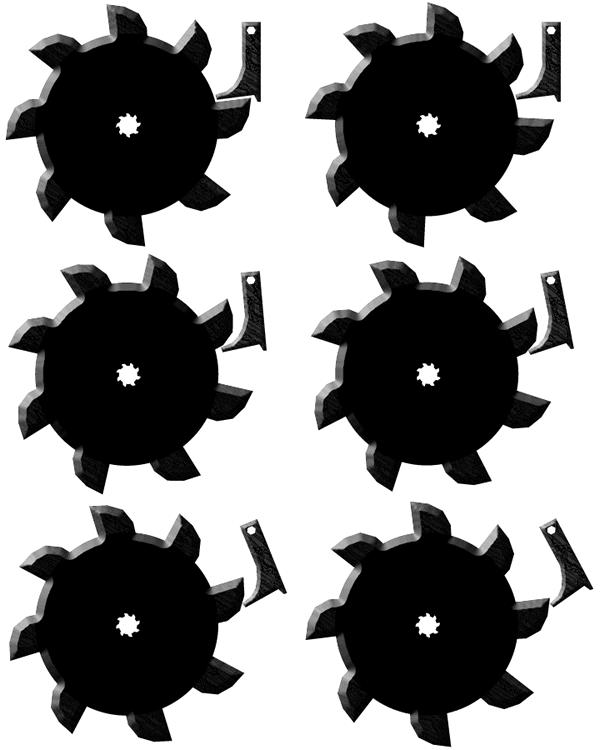
Evolutionary ratchets map the degree of movement freedom in a mechanical ratchet to increases and decreases in mutability and/or fitness (e.g. axes of variation). These fluctuations are then constrained to net increases in these variables.
To explain apparent directionality in evolution, three ratchet-like mechanisms (type I) have been explained: the epistatic, Muller’s, and cognitive ratchets. The epistatic ratchet is driven by epistatic interactions, so that mutations key to defining functional changes depend on corresponding mutations in genes of smaller effect [2]. For Muller’s ratchet, high mutation rates and neutral processes work together to produce a bias towards genotypes with a greater number of mutations [3].
In the case of both epistatic and Muller’s ratchets, mutational change becomes directional [4] rather than a random walk [4.1]. While this type of mutational change appears at first glance to be directed in some top-down manner, Maynard-Smith and Szathmary [4.2] show that it can be spontaneous by proposing a ratchet-like process called contingent irreversibility. In a similar but goal-directed manner, the cognitive ratchet works at the scale of behavior, and relies on anticipatory (behavioral) abilities for certain behaviors to drive further evolution of these abilities over longer time-scales [5].
Thermal ratchets (type II) are an instance of a Brownian ratchet, which are driven by Brownian (or quasi-random) noise [6]. In Huxley and Simmons [7] describe how thermal fluctuations allow for myosin heads to bind actin filaments under strain. This configuration generates tension and ultimately movement (e.g. kinesis). These observations were incorporated into the dominant theory of how muscle fibers contract (e.g. sliding filament theory – see Figure 2). While other types of natural ratchet are largely metaphorical, the physics of type II natural ratchets are the most similar to the physics of a simple machine-style ratchet.
Figure 2. A visual description of sliding filament theory (e.g. a thermal ratchet that drives contraction). COURTESY:
Engrade.
The next two types of ratchet (type III) involve the transmission and expression of genetic material, respectively. In the case of a gene transfer ratchet, the ratchet mechanism is used to explain the acquisition of bacterial genes by Eukaryotes [8]. Theoretically, it is suggested that early Eukaryotes acquired bacterial genomes from the bacteria consumed as food. Enhancer action ratchets push a genome's regulatory machinery towards bistability for chromatin markers of specific regulatory regions, which further enable changes in gene expression during a biological process [9].
The last three types of ratchet (type IV) have relevance to cellular and organismal movement. The directed tissue movement ratchet is driven by selectively-times pulsed forces that occur during tissue differentiation and organization in development [10]. The filament-pulling (diffusive) ratchet relies on a protein’s interactions with the geometry of cell bodies to enable functions such as DNA segregation during mitosis [11]. Figure 3 demonstrates this in an ex vivo setting. Finally, bacterial motors are ratchet-like mechanisms used to enable bacterial motility, usually through a flagellar structure [12].
But what enables directional behavior what are essentially undirected processes? In some cases (such as epistatic effects or Brownian ratcheting), a mechanism called stochastic resonance might be responsible [13]. Stochastic resonance (see Figure 4) involves the emergence of order by adding a noisy signal to a process which is already embedded in noise. This provides a route to order from chaos without any sort of intelligence.
And while there are no hard and fast rules to being noisy, the basic idea is that randomness can help define (or at least constrain) the system of interest [14]. A second possible mechanism involves a source of information acting as driver of the ratcheting mechanism. This is, in principle at least, similar to the Szilard engine that is supposed to provide directionality to entropic processes [15].

Figure 3. Instances of geometry sensing and the filament-pulling (diffusive) ratchet. TOP: diffusive coupling at different constants (from Supplementary Movie 8 in [11]). BOTTOM: Min protein on various membrane geometries (from Supplementary Movie 6 in [11]).
Figure 4. An example of stochastic noise (and resonance) in visual stimuli. Add white noise to the image, and it contributes to resolution of the underlying pattern. COURTESY:
Wikipedia.
Full Citations and Notes:
[1] Carlsson, A.E. Actin dynamics: from nanoscale to microscale. Annual Reviews in Biophysics, 39, 91-110 (2010).
For a more general review, please see this paper: Reimann, P. and Hanggi, P. Introduction to the physics of Brownian motors. Applied Physics A, 75, 169-178 (2002).
[2] Bridgham, J.T., Ortlund, E.A., and Thornton, J.W. An epistatic ratchet constrains the direction of glucocorticoid receptor evolution. Nature, 461, 515-519 (2009). See also the related concept of constructive neutral evolution (CNE):
[2.1] Lukes, J., Archibald, J.M., Keeling, P.J., Doolittle, W.F., and Gray, M.W. How a neutral evolutionary ratchet can build cellular complexity. IUBMB Life, 63(7), 528-537 (2011).
[2.2] Atkins, A.R. and Lambowitz, A.M. A protein required for splicing group I introns in Neurospora mitochondria is mitochondrial tyrosyl-tRNA synthetase or a derivative thereof. Cell, 50, 331–345 (1987).
[2.3] Stoltzfus, A On the possibility of constructive neutral evolution. Journal of Molecular Evolution, 49(2), 169-181 (1999).
[3] Muller, H.J. The relation of recombination to mutational advance. Mutation Research, 1(1), 2–9 (1964).
[4] Evolutinary ratchet mechanisms are closely tied to random and/or neutral processes, as demonstrated in these two references:
[4.1] Codling, E.A., Plank, M.J., and Benhamou, S. Random walk models in biology. Journal of the Royal Society Interface, 5(25), 813-834 (2008).
[4.2] Maynard Smith, J. and Szathmary, E. The Major Transitions in Evolution. Oxford University Press, Oxford UK (1995).
[5] Riegler, A. The Cognitive Ratchet: the ratchet effect as a fundamental principle in evolution and cognition. Cybernetics and Systems, 32, 411–427 (2001).
[6] Longtin, A. Stochastic dynamical systems. Scholarpedia, 5(4), 1619 (2010).
[7] Huxley, A.F. and Simmons, R.M. Proposed Mechanism of Force Generation in Striated Muscle. Nature, 233, 533-538 (1971).
[8] Doolittle, W.F. You are what you eat: a gene transfer ratchet could account for bacterial genes in eukaryotic nuclear genomes. Trends in Genetics, 14, 307-311 (1998).
[9] Narula, J., Smith, A.M., Gottgens, B., and Igoshin, O.A. Modeling Reveals Bistability and Low-Pass Filtering in the Network Module Determining Blood Stem Cell Fate. PLoS Computational Biology, 6(5), e1000771 (2010).
[10] Solon, J., Kaya-Copur, A., Colombelli, J., and Brunner, D. Pulsed Forces Timed by a Ratchet-like Mechanism Drive Directed Tissue Movement during Dorsal Closure. Cell, 137, 1331-1342 (2009).
[11] Schweizer, J., Loose, M., Bonny, M., Kruse, K., Monch, I., and Schwille, P. Geometry sensing by self-organized protein patterns. PNAS, 109(38), 15283-15288 (2012).
[12] Di Leonardo, R., Angelani, L., Dell’Arciprete, D., Ruocco, G., Iebba, V. Schippa, S., Conte, M.P.,
Mecarini, F., De Angelis, F., and Di Fabrizio, E. Bacterial ratchet motors.PNAS, 107, 9541-9545 (2010).
[13] Rouvas-Nicolis, C. and Nicolis, G. Stochastic resonance. Scholarpedia, 2(11), 474 (2007).
[14] Wimsatt, W. Randomness and perceived randomness in biological systems. Synthese, 43, 287-329 (1980).
Interesting linkages between randomness (in the algorithmic sense) and evolutionary biology from a biologist's point of view.
[15] Parrondo, J.M.R. The Szilard engine revisited: entropy, macroscopic randomness, and symmetry breaking phase transitions. Chaos, 11(3), 725-733 (2001).
Also see this Cosmic Variance blog post on the connection between information and thermodynamic entropy: Carroll, S.
Using Information to Extract Energy. Cosmic Variance blog. November 22 (2010).