Showing posts with label lectures-Figshare. Show all posts

February 9, 2017

OpenWorm Open House Videos

To recap from a previous post, the OpenWorm Foundation held its first virtual Open House in October in order to showcase all current projects and their status. After a YouTube video streaming snafu and a period of playing video capture catch-up, the YouTube portion of the OpenWorm Open House is now live! 


The first Open House YouTube playlist is the Flash talk series,which covers all of the projects under the Foundation's umbrella. This playlist currrently includes all but two videos on the session program. While the original stream is being repaired, please check out the playlists.


The second Open House YouTube playlist features two tutorials (longer sessions of 45 minutes) that originally ran in parallel. We also have an permenant and citable archive at Figshare (doi:10.6084/ m9.figshare.4331036), which includes the videos along with supplemental papers and presentations. While the download is large, it is worth checking out. Enjoy!

May 15, 2013

Lecture to BEACON Center, Michigan State

On May 17th (Friday) at 3:30pm (EST), I will be giving a lecture entitled "Adventures in Quasi-Evolution" [1] to the BEACON Center [2]. The audience is Thrust Group 1 (Genomes, Networks, and Evolvability).


The first half of my talk will be on computational models of cellular reprogramming (e.g. evolutionary modulus, or the engineering on the remnants of evolutionary and developmental variation). The second half is some emerging work I am doing on the cultural evolution of economic value (e.g. evolutionary through the looking glass, or how evolutionary models [3] may explain current economic puzzles).


NOTES:

[1] "Adventures in Quasi-Evolution". Figshare, doi:10.6084/m9.figshare.701463 (2013). I define quasi-evolution as "changes over time not due to reproductive fitness or generational inheritance".

[2] For those who are unfamiliar, the BEACON Center (an NSF-funded center) is a multi-disciplinary, multi-University group interested in the intersection of biology and engineering with relevance to evolution. Catch the lecture at one of these locations:

Michigan State University: Biomedical and Physical Sciences Building, Room 1441 (BEACON seminar room), 3:30pm.

North Carolina A and T University: McNair Hall, Lecture Room 4, 3:30pm.

University of Idaho: Life Sciences South (LSS), Room 144, 12:30pm

University of Texas, Austin: Service Building (SER), Room 321H, 2:30pm.

University of Washington: UW Hutchinson Cancer Center, Building PAA Room 023D, 12:30pm

[3] The cultural evolutionary models used in my research are called Contextual Geometric Structures (CGSs). Contextual Geometric Structures (CGS) will never play chess well, or perhaps at all. They will never beat Ken Jennings on Jeopardy. That's not the point. They exist as soft or fuzzy (e.g. possibilistic, non-transitive) classifiers that capture (or at least reproduce) the structural features of cultural behavior. This is quite different from the dual inheritance models that are common in studies that focus on the geneaology of traits.


The "structure" of culture has been observed and pondered by many cultural anthropologists, from Claude Levi-Strauss to Pierre Bourdieu. Bourdieu used a construct called the "habitus" to characterize the relationship between individuals in a single generation and cultural structures that exist across multiple generations. CGSs provide a measure of computational precision (e.g. a kernel function)  to this and other conceptions of "cultural logic".

As a quasi-evolutionary phenomenon, CGSs are designed to capture neither the dual inheritance of genes and culture nor the connectionism of a traditional cognitive model. The outcomes of CGS agents are not geared towards optimal decision-making. Rather, they classify natural phenomena according to a set of discrete oppositions (or categories).

Some of these are based on premises (e.g. historically-determined preferences), while others are based on biological features of the organism. The CGS agents then use the classificatory state of other agents as a cue to either follow (conform) or disperse (dissent). What results is a form of social learning that can be used to update (or obliterate) the space between the lower-level categories.

CGS simulations can be run either in an liquid-like simulation, or independently. In the original conception, which maps CGSs to geographic and other spatial phenomena, a hybrid model was proposed. In experiments geared towards understanding the social construction of economic value, populations of CGS kernels and their agents are static with respect to spatial position. However, they exchange items and attach value to those items based on repeated interaction.

For more information, please see:
Alicea, B.  Contextual Geometric Structures: modeling the fundamental components of cultural behavior. Proceedings of Artificial Life, 13, 147-154 (2012).

April 20, 2013

Replication, Model Organisms, and the Role of Evolutionary Signatures

The following slides and commentary focus on an open problem that involves the difference in perspective between medical researchers and evolutionary biologists. By perspective, I mean the types of explanatory frameworks one uses to understand a set of results.

Notice that I could have used the word "theory", but it actually has more to do with the cultural premises of one's discipline and formal training [1], especially in cases where there is a lack of good theory.

These slides are the second part of a talk of mine called "If your results are unpredictable, does it make them any less true? (posted to Figshare), which is a follow-up on the HTDE 2012 Workshop.


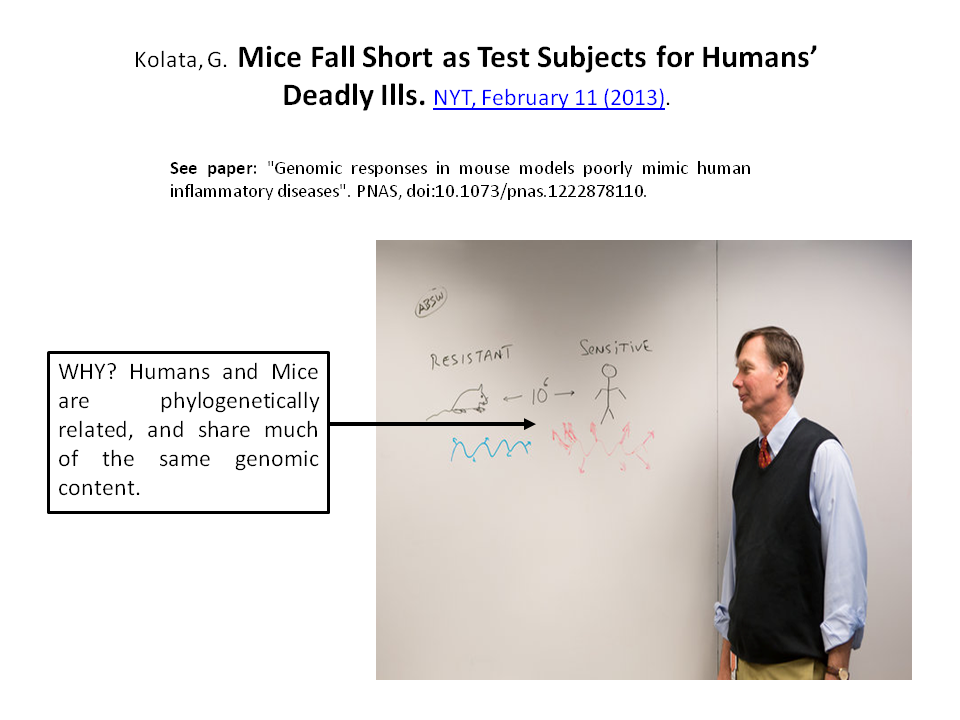
This set of slides was inspired by an in-lab discussion about a news article, that lead me to a recent PNAS paper on sepsis research in mice and humans. While mice are the accepted model organism for studying sepsis [2], it turns out that the physiological response (e.g. microarray studies and gene expression correlations) to sepsis in humans is very different than in mice. 

This result is interesting from an evolutionary standpoint. While there is phylogenetic distance between mice and humans, they are both mammals and certainly share many physiological and genomic characteristics. Furthermore, can these differences be explained using evolutionary theory? Has there been evolution in the sepsis response between mice and humans, or are these differences due to a highly variable response that can vary widely between species (and perhaps even between individuals in the same species)?


The variation in pathway activation and physiological responses seems to be quite common in medical research. When a certain experimental manipulation is done to multiple species [3], there is a range of possible outcomes, from a common response to a widely varying responses. We will return to this later. 

For now, let's consider why such massive differences might exist between humans and mice for a single physiological response. This is where we must return to the issue of premises. Given your background and preferences, you might choose a single explanatory framework. 

I have presented three in the slide below:  black box, complexity, and noise. Each of these may find support depending on the measures used and physiological components assayed. Yet each of them used in isolation may not be particularly satisfying, nor even explain very much of the data by themselves. This is why good, unified theories are of such value.


Another important aspect of understanding this variable response is to rule out alternative hypotheses. In the slide below, I consider three potential artifacts that could unduly influence the animal model results: standardization of environmental conditions, artificial selection on the model organism population due to selective breeding, and the tendency of the experimenter to put more weight on features of the experimental design or analysis that allow for greater experimental replication within a particular species. Particularly in the case of the first and last point, the lesson is that standardization of the experimental setting may actually do more harm than good and introduce ecological validity problems.


Now I present my interpretation of what is going on with the sepsis result. This consists of two hypotheses that can be applied to each species (human and mouse). The first is that the physiological response to sepsis is exact, which utilizes the same pathways and same patterns of gene expression across most conspecifics but only within a single species. This might require mutational distance and other evolutionary changes among the genes that explain the sepsis phenotype. 

The alternate hypothesis says that the physiological response to sepsis is variational, which means that there is potentially great variation is mechanism across most members of the same species. This variation need not be due to heritable mutation, but simply a lack of specificity in the molecular pathways and other associated mechanisms. In this case, there would be differences between human and mouse far greater than a consensus phylogeny might suggest.


What is a variational response? The term "variational" [4] is taken (perhaps loosely) from the mathematics and physics literature, and is generally used to describe a system with many potential solutions. In this context, the goal of the variational method is to approximate potential solutions based on optimizing their properties. 

One example can be shown in the slide below: two alternate routes from Toronto to Vancouver. Each route is the "shortest" route using two pathway criterion. One pathway is tightly restricted to the Trans-Canadian highway, while the other allows for an alternate route along a number of US interstates (e.g. 5, 90, 94). Both routes are about the same number of kilometers in length (e.g. number of steps in a physiological pathway). Yet they might be alternately used due to the in-capacitation of one pathway or the other [5].


The slide below shows these hypotheses in a phylogenetic context. As a contingency table, we consider the exact and variational scenarios for both conserved and divergent mechanisms. In the case of a conserved mechanism, there is very little mutational change to the underlying genes or pathway. For a divergent mechanism, the opposite is true.


To further understand what is meant by evolutionary conservation (and how it affects the consistency of physiological responses across species), I will now discuss two examples from the literature: the regulation of stress and aging, and the use of zebrafish as a human analogue. This will hopefully put my evolutionary speculations in context.

In aging research, phylogenetically-divergent species such as yeast and flatworms are used to understand the substrate of interventions such as caloric restriction and the activity of pathways related to stress resistance. As Longo and Fabrizio [6] demonstrate using aggregated data (see below slide), the associated pathway architectures are quite invariant across yeast, flatworms, and humans. However, this may not involve the same genes form species to species. In cases where conserved genes are known to be involved, it is not clear whether this conservation of mechanism components extends to a conserved mechanism itself.


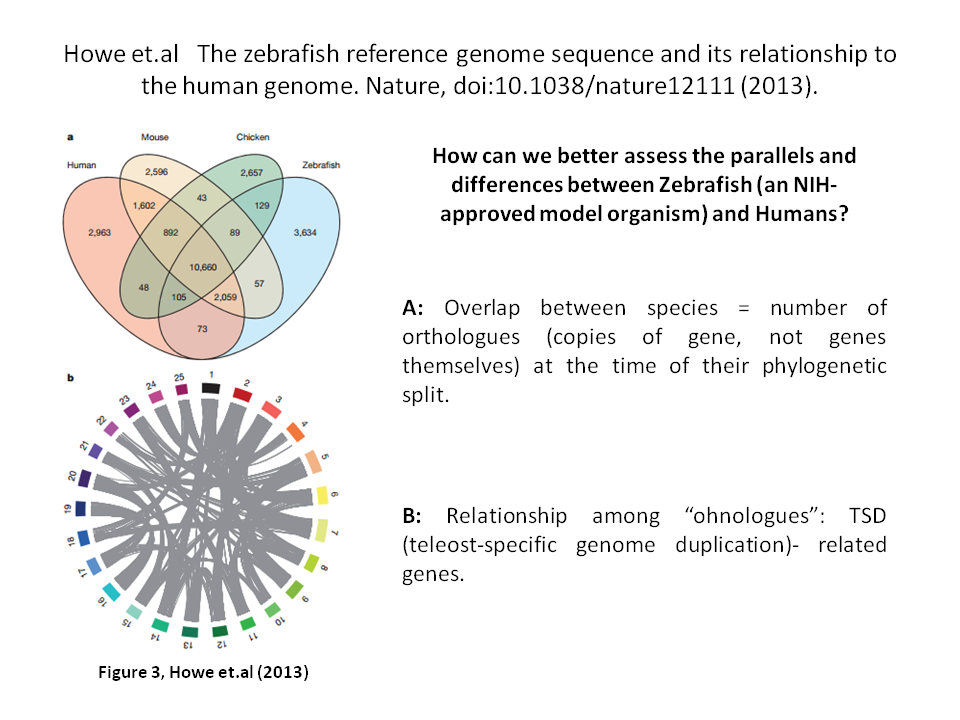
A recent set of papers [7] focuses on comparing the genomes and proteomes of zebrafish with humans. As zebrafish and humans diverged around 440 million years ago [8], we would expect there to be vast differences in both function and genomics. However, there are occasionally greater differences among zebrafish than between zebrafish and humans. Another puzzle similar to the sepsis story, excpet that now we have extensive characterization of the genome and proteome to work from.

In the slide below (taken from Figure 3 of the Howe et.al paper), we can see how orthologues are shared by zebrafish and human as well as the relationship between so-called ohnologues in the zebrafish genome. Data such as these may provide good future estimates on how and why differences exist when evaluating variation related to basic physiological functions with and between zebrafish and humans.


So what can be learn from the big picture? Particularly when distinguishing between the homogeneity expected from experimental replication and the heterogeneity posed by natural variation? Perhaps we can treat experimental replication as a generative model, where the basic experiment is expected to reveal a range of likely outcomes. Like generative models in machine learning, the goal of analysis is to pick the best model (or in this case, the set of data that provide the closest match to what we know about the underlying natural phenomenon). 

This is a tricky proposition, because both the possible set of experimental and natural outcomes are incompletely known. Nevertheless, as in the case of understanding physiological processes and outcomes as variational processes, we can make good approximations that provide high explanatory power [9] without over-relying on the replication of results.


NOTES: 

[1] cultural premises are also known as "point of view". See this Tumbld Thoughts post for a detailed review.

From two wildly different premises: a painting entitled "Picasso and Dali Paint an Egg" (Artist unknown).

[2] model organisms are used conduct experiments that are either unethical or impossible to engage in with human subjects. Here is the full NIH list of model organisms. The accepted human analogues range from fruit flies (Drosophila) to mice (Mus musculus) and round worms (C. elegans) and zebrafish (Danio rerio). A newer trend is to use domesticated animals (e.g. sheep, cows, goats, pigs) as (non-traditional) model organisms.

Please see the following papers for more information on cross-species comparisons of model organisms with relevance to disease:

Golstein, P., Aubry, L., and Levraud, J.P.   Cell-death alternative model organisms: why and which? Nature Reviews Molecular and Cell Biology, 4(10), 798-807 (2003).

Goldstein, P.   Cell death in unusual but informative and beautiful model organisms. Seminars in Cancer Biology, 17(2), 91–93 (2007).

[3] this effect can be observed (usually understood via anecdotal reporting methods) both in vivo and in vitro (cell culture models). 

[4] the variational principle is widely used in quantum physics and engineering to arrive at solutions in very large, complex systems. Why not a version of this idea for physiological systems analysis?

[5] this suggests a role for mechanisms such as robustness, evolvability, and degeneracy.

[6] Longo, V.D. and Fabrizio, P.   Regulation of longevity and stress resistance: a molecular strategy conserved from yeast to humans? CMLS: Cellular and molecular life sciences, 59(6), 903-908 (2002).

[7] Here are a host of relevant papers (including a recent feature article in Nature):
a. Varshney, G.K. et.al   A large-scale zebrafish gene knockout resource for the genome-wide study of gene function. Genome Research, 23, 727-735 (2013).

b. Kettleborough, R.N.W. et.al   A systematic genome-wide analysis of zebrafish protein-coding gene function. Nature, doi:10.1038/nature11992 (2013).

c. Schier, A.F.   Zebrafish earns its stripes. Nature, doi:10.1038/nature12094 (2013).

d. Howe, K.   The zebrafish reference genome sequence and its relationship to the human genome. Nature, doi:10.1038/nature12111 (2013).

e. Barbazuk, W.B.   The Syntenic Relationship of the Zebrafish and Human Genomes. Genome Research, 10, 1351-1358 (2000).

[8] data derived from multiple consensus phylogenies (a meta-meta analysis) curated by Timetree.org. 

[9] This was cross-posted to my micro-blog, Tumbld Thoughts:


A new paper by Button et.al [a] featured in Wired Science claims that research in the Neurosciences are plagued with low statistical power (e.g. explanatory capacity of significant results), which is based on an 2005 paper by John Ioannidis [b] that applies a measure called positive predictive value (PPV) for determining the reliability of results in a particular scientific field (top image). While Ioannidis originally focused on results in Psychology, in later papers he has extended this line of inquiry to Computational Biology (e.g. microarray analysis) [c].

This reliability can be compromised by something called the proteus phenomenon [d], which deals with drawing a consensus from a series of datasets that exhibit similar biases. Two potential examples of this can be seen in a meta-meta analysis of the Psychological literature (Figure 3) from [a], and the Social Psychology literature. In the case of the latter, a paper from Vul et.al [e] investigates the exceedingly high correlations between brain activity data yielded from neuroimaging data and personality (e.g. self-reported) measures. Does this mean that there truly IS a high correlation, or is a subtle bias at work here?


Whether or not these concerns are overblown is up for debate, and it may be an artifact of the way we test for significance (e.g. NHST) rather than inherent problems with the method of experimental replication [f]. Fortunately, people are trying to address some of these issues (bottom image). Examples include the Equator Network [g] and the reproducibility project [h], both of which advocate open science. And, of course, there are more philosophically-oriented issues that I have started to address with the Hard-to Define Events (HTDE) approach.

For Reference 9, see also:
[a] Button, K.S., Ioannidis, J.P.A., Mokrysz, C., Nosek, B.A., Flint, J., Robinson, E.S.J., and Munafo, M.R.   Power failure: why small sample size undermines the reliability of neuroscience. Nature Reviews Neuroscience, doi:10.1038/nrn3475 (2013).

[b] Ioannidis, J. P.   Why most published research findings are false. PLoS Medicine, 2, e124 (2005).

[c] Ioannidis, J. P. et.al   Repeatability of published microarray gene expression analyses. Nature Genetics, 41, 149–155 (2009).

[d] Pfeiffer, T., Bertram, L. & Ioannidis, J. P. Quantifying selective reporting and the Proteus phenomenon for multiple datasets with similar bias. PLoS ONE 6, e18362 (2011).
"The chances for non-significant studies going in the same direction as the initial result are estimated to be lower than the chances for non-significant studies opposing the initial result"

[e] Vul, E., Harris, C., Winkielman, P.,  and Pashler, H.   Puzzlingly High Correlations in fMRI Studies of Emotion, Personality, and Social Cognition. Perspectives on Psychological Science, 4, 274 (2009). Also see Ed Vul's site on "voodoo correlations".

[f] for more information on the BEST test (an alternative to tests of the null hypothesis), please see: Kruschke, J.K.   Bayesian estimation supersedes the t test. Journal of Experimental Psychology: (2012).


March 26, 2013

Upcoming Second Life Lecture and Summary Talk

This is cross-posted from my micro-blog, Tumbld Thoughts:


Here are slides from a lecture [1] to be given this Wednesday (March 27) to the Embryo Physics group (in Second Life) at 2pm PST. Slides posted to Figshare. A shorter version of the talk was originally part of HTDE 2012, a workshop in association with the Artificial Life XIII conference.

Selected slides from talk


Also, I am currently on the job market. Here is a short slideshow [2] that profiles my personal research expertise and interests (and the current version of my CV, which can be found here). Please take a look at both, and comments are welcome.


NOTES:

[1] Alicea, B.   Multiscale Integration and Heuristics of Complex Physiological Phenomena. Figshare, doi: 10.6084/m9.figshare.657992 (2013).

[2] Alicea, B.   Short Job Talk. Figshare, doi:10.6084/m9.figshare.639185.

UPDATE:
The talk went well, with about six avatars in attendance (I am the Tron lightcycle avatar). Below are some images from the proceedings, with a transcript of the talk also available.


February 25, 2013

Innovation-palooza for February

Here are a couple more cross-posts (on Hard-to Define Events and Scientific Innovation, respectively) from my micro-blog, Tumbld Thoughts.


A. Take a look at the link [1] to a slideshow I am presenting in the near future as a follow-up to the Hard-to-define Events workshop I organized last summer. It is called "If your results are unpredictable, does it make them any less true?", and focuses on applying the hard-to-define events paradigm to biology and the development of scientific theory.


B. And here is an article from Joe Nocera of the NYT called "Innovation Nation at War" [2]. It is a critical assessment of the current patent system and how it is hurting the innovation economy. Specifically, he discusses patents in terms of their economic utility, and how companies buy patent portfolios and file patent lawsuits [3] in a manner that severely violates this principle. Perhaps a better solution would be a bond system ties to ideas futures, which would provide a more immediate payoff with less legal jujitsu [4].


C. As an added bonus, here is a podcast (courtesy of the NanoNerds YouTube channel) with Brian Bergstein from MIT Technology Review on the top ten emerging technologies of 2012. The continued development of cheap nanopore DNA sequencing technology is my favorite.

NOTES:


[2] here is a real-time update of the "Tweetscape" for this article. Interesting comments.

[3] A conflict termed the "patent wars". Interesting infographic here.

[4] The martial arts is figurative, but the legal maneuvering is quite real (see here for an example on the anti-commons). See diagrams above for more information. These are some ideas I have been developing, and stand in comparison to intellectual property-oriented patents.


January 21, 2013

Freedom of information versus the economics of information


This content is being re-posted from my microblog, Tumbld Thoughts.


This is a follow-up to my last Synthetic Daisies post, and turns the argument (should information be free of cost and/or financial value) on its heads [1]. Would you like to be paid to read books? Does this sound too good to be true? Actually, this is an idea from Kevin Kelly (of Wired fame) at his blog "The Technium". A bit like the "economics of the free" [2] and some of the ideas advanced in my recent slideshow on science innovation [3].

[1] Does information want to be free? Or in this case, of "negative value" to the creator? In this case, any negative value is temporary, and actually becomes a strategic investment. This is more like the electricity consumer who (through the use of renewables) supplies energy back to the electric grid rather than the investor who gets negative interest on their savings account.

[2] For more information, please see the book "Free" by Chris Anderson. Could you replace the concept "books" and "reading" in Kelly's model with any other concept? There may or may not be a free lunch today, depending on your reading of "Free".

[3] A New Route to Science Innovation, doi:10.6084/m9.figshare.106823. In addition, there are some interesting relationships between this model and the potential monetization of social capital. This would be especially powerful if Kelly's model were implemented on a large social media network (e.g. Facebook or LinkedIn).

January 15, 2013

Does information want to be free?

Just finished preparing my lecture on alternatives to the IP/government grant science funding regime (slides on Figshare), when I heard that Aaron Schwartz (founder of Reddit, open-source advocate) committed suicide. Will he become a martyr for the open-source movement? Below is his open-source publishing call-to-arms called the Guerilla Open Access manifesto, which I am reposting here with comments (no permissions needed). R.I.P. Aaron.

Aaron Schwartz, as featured in Talking Points Memo (TPM) article.

Information is power [1]. But like all power, there are those who want to keep it for themselves. The world’s entire scientific and cultural heritage, published over centuries in books and journals, is increasingly being digitized and locked up by a handful of private corporations. Want to read the papers featuring the most famous results of the sciences? You’ll need to send enormous amounts to publishers like Reed Elsevier [2].

There are those struggling to change this. The Open Access Movement has fought valiantly to ensure that scientists do not sign their copyrights away but instead ensure their work is published on the Internet, under terms that allow anyone to access it. But even under the best scenarios, their work will only apply to things published in the future. Everything up until now will have been lost.

That is too high a price to pay. Forcing academics to pay money to read the work of their colleagues? Scanning entire libraries but only allowing the folks at Google to read them? Providing scientific articles to those at elite universities in the First World, but not to children in the Global South? It’s outrageous and unacceptable.

“I agree,” many say, “but what can we do? The companies hold the copyrights, they make enormous amounts of money by charging for access, and it’s perfectly legal — there’s nothing we can do to stop them.” But there is something we can, something that’s already being done: we can fight back.

Those with access to these resources — students, librarians, scientists — you have been given a privilege [3]. You get to feed at this banquet of knowledge while the rest of the world is locked out. But you need not — indeed, morally, you cannot — keep this privilege for yourselves. You have a duty to share it with the world. And you have: trading passwords with colleagues, filling download requests for friends.

Meanwhile, those who have been locked out are not standing idly by. You have been sneaking through holes and climbing over fences, liberating the information locked up by the publishers and sharing them with your friends.

But all of this action goes on in the dark, hidden underground. It’s called stealing or piracy, as if sharing a wealth of knowledge were the moral equivalent of plundering a ship and murdering its crew. But sharing isn’t immoral — it’s a moral imperative [4]. Only those blinded by greed would refuse to let a friend make a copy.

Large corporations, of course, are blinded by greed [5]. The laws under which they operate require it — their shareholders would revolt at anything less. And the politicians they have bought off back them, passing laws giving them the exclusive power to decide who can make copies.

There is no justice in following unjust laws. It’s time to come into the light and, in the grand tradition of civil disobedience, declare our opposition to this private theft of public culture.
We need to take information, wherever it is stored, make our copies and share them with the world. We need to take stuff that's out of copyright and add it to the archive. We need to buy secret databases and put them on the Web. We need to download scientific journals and upload them to file sharing networks. We need to fight for Guerilla Open Access [6].

With enough of us, around the world, we’ll not just send a strong message opposing the privatization of knowledge — we’ll make it a thing of the past. Will you join us?

Aaron Swartz
July 2008, Eremo, Italy

NOTES:
[1] Indeed. More specifically: Knowledge is power, but those who control access to that knowledge have the real power.

[2] Here is a link to the academic scientist-lead Elsevier boycott. Interestingly, many of the high-profile open-source journals also charge a publishing fee for authors but keep access free. While this is good for sharing information, it could still exclude citizen scientists from broadcasting information.

[3] The economics of librarianship are vastly different from the market economics of, say, the entertainment industry. Part of this is due to the intangibility of the product, but a comparison between traditional libraries and entertainment markets are a good comparison (the objects of exchange are similarly intangible -- unlike land or objects such as cars, it is hard to discretize, enclose, and assign value to these units). I did not cover this directly in my talk, but it brings up a host of interesting issues.

[4] The mores of downloading (or sharing information in all its forms) are not clear. Is it righful sharing? Or is unrestricted downloading a form of theft? Here is a New York Times story on the Megaupload case, a legal perspective on digital "theft". And here is a list of content theft in all its forms from the MPAA. As a rebuttal to the NYT story, here is a Freakonomics blog post on why downloading is not theft. And finally, here is a Wired opinion piece on how "piracy" (the online dissemination of music, movies, and books) is simply the next step in publishing's technological evolution. In general, people have quite strong moralistic positions on this despite the inherent intangibility of the information in question.

[5] It is not so much that corporate entities are blinded by greed, but rather that their raison d'etre is to extract rent from both the creators of content and the consumers of content. This might make sense in a world where technology restricts how this information is distributed to the audience, or in cases where the costs are minimal and the benefits have the potential to be highly advantageous to the creator, but probably makes little sense in an age of high-bandwidth internet access. In other words, the proprietary journals et.al must now prove their worth.

[6] For more information (not neccessarily of the Guerilla variety) on how to be more open access-friendly, please see two recent blog posts:

1) What your can do to promote open access (Peter Suber).

2) 10 things you can REALLY do to support Open Access (Michael Eisen, "Tree of Life").

In addition, Dan Cohen (at Wired Blogs) wrote a post in tribute to Aaron Schwartz called "How to Make Open-Access Work". Fits well within the scope of my talk.

ADDED ON 1/17: A group of Mathematicians have just announced that the Episciences project (open-source peer-review system and journal) will commence soon as an arXiv overlay journal. Good luck!

Printfriendly