Showing posts with label spatial-geo. Show all posts

February 12, 2021

Assorted Darwin Day Content


For this year's Darwin Day post, I will highlight a number of items I have recently run across on Twitter. Some of these have been retweeted on the Orthogonal Research and Education Lab Twitter feed, other materials are related to discussions in our research group meetings.

To start things off, I will draw your attention to a new special issue of Royal Society of London B called "Basal cognition: multicellularity, neurons and the cognitive lens" that is worth checking out. The term "basal" refers to evolutionary origins in the context of phylogeny (the tree of life)


The new paper on elementary nervous systems in Royal Society B (click to enlarge, figure from paper). COURTESY: Detlev Arendt.

A pointer to the Darwin Online repository.

In terms of old drawings and other archival materials, check out the Darwin Online project. This is a nice repository of Darwin-related historical and scientific works. This resource contains books, personal correspondence, and published materials. Speaking of history, let's turn to the deep history of life.....

A billion years of continental drift as an animated gif. Click to enlarge.

This next feature is a new paper on a billion years of plate tectonic dynamics: "Extending full-plate tectonic models into deep time: Linking the Neoproterozoic and the Phanerozoic" by Mike Tetley and colleagues. Now published in Earth Science Reviews, it is something we recently discussed in the weekly DevoWorm group meeting.

Following up on the DevoWorm discussion, which was about mapping the continental drift animation to the most basal branches of the tree of life, is an attempt to map Mammalian phylogeny [1] to continental drift over the past 225 million years. This was created by Carlos E. Alvarez. The numbers on the maps (top) correspond to the numbered clades (subtrees - bottom). This topic deserves a deeper dive into the latest Phylogeography research [2], which may be the subject of a future blog spot.

An attempt at matching up the tree of life with continental drift (click to enlarge). COURTESY: Carlos E. Alvarez

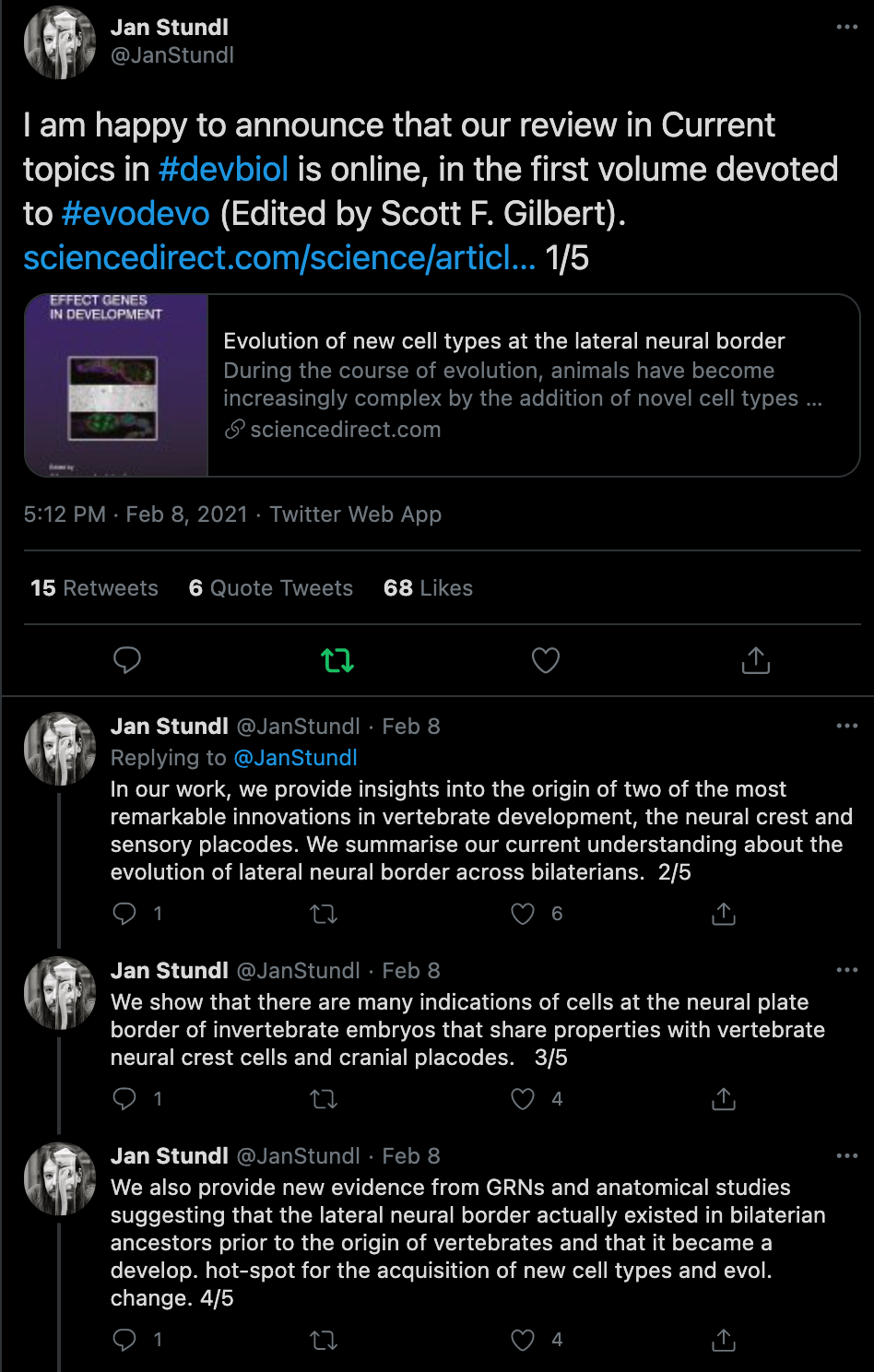
The next feature is a new paper on evolution of development (evo-devo) in nervous system anatomy called "Evolution of new cell types at the lateral neural border", now published in Current Topics in Developmental Biology. This study even uses converging evidence from genetic regulatory networks and anatomy to demonstrate common mechanisms shared between invertebrates and vertebrates.

A new paper on the evolution of new neuronal cell types (click to enlarge). COURTESY: Jan Stundl (Caltech).

Not only is this Darwin Day, but also the 50th anniversary of a Nature paper by Kimura and Ohta [3] on the Neutral Theory of Molecular Evolution. Neutral Theory postulates that most biological variation is expressed in selectively neutral genes, and so is random in nature [4]. This stands in opposition to the selectionist perspective of evolutionary change [5, 6].


Fully-tweetable neutral theory of evolution. COURTESY: Andrew J. Crawford.

Finally, and returning to neuroevolution, there are several items of interest from the laboratory of Cassandra Extavour. The first is a talk at the Society of Integrative and Comparative Biology meeting on the evo-devo-eco-neuro-biology of Drosophila learning and memory. For more evo-devo work from Dr. Extavour's lab, check out this recent work (with open data) on insect size and shape [7, 8].

Original artwork from SICB Twitter Account, commentary from Ken A. Field.

Hand-drawn notes on the SICB plenary talk. COURTESY: Dr. Ajna Rivera.

NOTES:

[1] Foley N.M., Springer M.S. and Teeling E.C. (2016). Mammal madness: is the mammal tree of life not yet resolved? Philosophical Transactions of the Royal Society B, 37120150140. doi:10.1098/ rstb.2015.0140.

[2] Avise, J.C. (2000). Phylogeography: the history and formation of species. Harvard University Press, Cambridge, MA.

[3] Kimura, M. and Ohta, T. (1971). Protein Polymorphism as a Phase of Molecular Evolution. Nature, 229, 467–469.

[4] Kimura, M. (1983). The Neutral Theory of Molecular Evolution. Cambridge University Press, Cambridge, UK.

[5] Nei, M. (2005). Selectionism and Neutralism in Molecular Evolution. Molecular Biology and Evolution, 22(12), 2318–2342. doi:10.1093/molbev/msi242.

[6] There are other critiques of selectionism from other perspectives. Here is one in the area of brain function: Fernando, C., Szathmary, E., and Husbands, P. (2012). Selectionist and Evolutionary Approaches to Brain Function: A Critical Appraisal. Frontiers in Computational Neuroscience, 6, 24. doi:10.3389/ fncom.2012.00024.

[7] Church, S.H., Donoughe, S., de Medeiros, B.A.S., and Extavour, C.G. (2019). Insect egg size and shape evolve with ecology but not developmental rate. Nature, 571, 58–62.

[8] Church, S.H., Donoughe, S., de Medeiros, B.A.S., and Extavour, C.G. (2019). A dataset of egg size and shape from more than 6,700 insect species. Scientific Data, 6, 104.

April 25, 2015

Reading Carnival, April Edition

A new feature here on Synthetic Daisies, which features a variety of readings from blogs, the popular press, and journals of both immediate and long-term interest. This edition features six pieces ranging topically from intellectual property and data analysis to evolutionary biology and complexity theory.


Haydari, S. and Smead, R.   Does Longer Copyright Protection Help of Hurt Scientific Knowledge Creation? JASSS, 18(2), 23 (2015).

An agent-based modeling approach (featuring a type of spatial lattice called an epistemic plane) is used to better understand how copyright protections can both enable and hinder knowledge creation. The model represents knowledge creation in two ways: knowledge can either either "discovered" by agents or remain "undiscovered". Discovered knowledge can be disseminated in either a high-access (proprietary) or open-access (freely-distributable) fashion. This distributed model of scholar behavior has revealed that extended periods of intellectual property protection can act to hinder innovation. While open-access can serve the public good, there is also a role for individual incentives which are served by limited periods of proprietary protection. Whether these returns are served through monetary compensation or social capital accumulation go unexplored.


Lind, P.A., Farr, A.D., and Rainey, P.B.   Experimental evolution reveals hidden diversity in evolutionary pathways. eLife, 10.7554/eLife.07074 (2015).

By examining 28 morphs of the wrinkly spreader phenotype in Pseudomonas fluorescens (a gram-negative bacterium), the authors were able to discover a number of new pathways through which diversity is generated. These unique pathways involved unique, uncharacterized mutations that provided variation to the existing taxonomic group. As instances of parallel evolution, they provided a means to suggest a set of principles that involve changing the regulation of genes followed by a change of function for those genes.


Kiers, E.T. and West, S.A.   Evolving new organisms via symbiosis. Science, 348(6233), 392-394 (2015).

A mini-review on the evolution of symbiont species and how it may account for major transitions in the tree of life.


Dennett, D. and Roy, D.   Our Transparent Future: No secret is safe in the digital age. Scientific American, 312(3), 32-27 (2015).

This essay compares the rise of information transparency, enabled through internet technologies, to the explosion of life's complexity as it occurred during the Cambrian explosion. As a result, the practice of information-handling by individuals and organizations will change due to key innovations. These innovations are analogous to the camera-like retinas, claws, jaws, and shells that emerged amongst animals during the Cambrian. A very Rodney Brooks-esque style argument for internet-enabled (or -forced, depending on your point of view) cultural evolution.


Ellenburg, J.   The Amazing, Autotuning Sandpile. Nautil.us, 23(1) (2015).

A popular science take on the Abelian Sandpile model and its role in pattern formation. The beginning of the article presents a neccessary contrast with the domino model of causality. Unlike a linear model of system dynamics (one event leads to another with a predictable timing), the sanpile model produces nonlinear dynamics with unpredictable timing. While both models involve a simplistic physical structure, but only one produces a highly complex output. Latter portions of the article focus on geometric abstractions (cellular automata) which produce self-organizing and "life-like" behavior.


Brown, C.T.   Cultural confusions about data - the intertidal zone between two styles of biology. Living in an Ivory Basement blog, April 2 (2015).

An interesting blog post (with links and comments) on the cultural meaning of data and what constitutes useful datasets when comparing both academic fields (e.g. computational biology vs. molecular biology) and research outputs (e.g. genome sequences vs. experimental outcomes).

April 22, 2015

Earth Day 2015 Links

Happy Earth Day 2015, by way of Google's Doodle series.


Here are some Earth Day Doodles of years past. And here is an op-ed piece on how the transition from fossil fuels is closer than the pundits believe. Then, enjoy the pale blue dot.

Earth from a slightly different perspective. You are somewhere in "there". COURTESY: Planetary society.


December 8, 2014

What Kind of Jurassic World Do We Live In?

Free-association and creative license at geologic timescales......

In a world where Gondwana has not yet fully drifted apart.....

COURTESY: Australian Museum.

And features a long-suffering movie idea that will probably end up being mediocre.....

Here is the "Jurassic World" trailer. COURTESY: Universal Pictures.

Satire still exists! Sort of.

A cynical take on the whole Jurassic World enterprise. COURTESY: xkcd.

October 10, 2014

The Grids of Nobel (Medial Temporal Lobe-rific)


This year's Nobel Prize in Physiology and Medicine went to John O'Keefe, May-Britt Moser, and Edvard I. Moser for their work on the neurophysiology of spatial navigation [1]. The prize was awarded "for their discoveries of cells that constitute a positioning system in the brain". Some commentators have referred to these discoveries as constituting an "inner GPS system", although this description is technically and conceptually incorrect (as I will soon highlight). As a PhD student with an interest in spatial cognition, I read (with enthusiasm!) the place cell literature and the first papers on grid cells [2]. So upon hearing they had won, I actually recognized their names and contributions. While recognition of the grid cell discovery might seem to be premature (the original discovery was made in 2005), the creation of iPS cells (the subject of the 2012 award) only dates to 2007.

John O'Keefe is a pioneer in the area of place cells, which provided a sound neurophysiological basis for understanding how spatial cognitive mechanisms are tied to their environmental context. The Mosers [3] went a step further with this framework, discovering a type of cell that provides the basis for a metric space (or perhaps more accurately, a tiling) to which place cell and other location-specific information are tied. The intersection points on this grid are represented by the aptly-named grid cells. Together, these types of cells provide a mental model of the external world in the medial temporal lobe of mammals.

Locations to which grid cells respond most strongly.

Place cells (of which there are several different types) are small cell populations in the CA1 and CA3 fields of the Hippocampus that encode a memory for the location of objects [4]. Place cells have receptive fields which represent specific locations in space. In this case, a cell's receptive field corresponds to locations and orientations to which the cell responds most strongly. When the organism is located in (or approaches) one of these receptive fields, the local field potential of the cell population is activated at a maximum of 20Hz. As place cells are in the memory encoding center of the brain, place cells respond vigorously when an animal passes or gets near a recognized location. Grid cells, located in the entorhinal cortex, serve a distinct but related role to that of place cells. While spatial cognition involves many different types of input (from multisensory to attentional), place cells and grid cells are specialized as a mechanism for location-specific memory.

Variations on a grid in urban layouts. COURTESY: Athenee: the rise and fall of automobile culture.

How do we know this part of the brain is responsible for such representations. Both place and grid cells have been confirmed through electrophysiological recordings. In the case of place cells, lesions studies [5] have been conducted to demonstrate behavioral deficits during naturalistic behavior. In [5], lesions (made via lesion studies) of hippocampal tissue results in deficits in spatial memory and exploratory behavior. In humans, the virtual Morris Water Maze [6] can be used to assess performance with regard to finding a specific landmark (in this case, a partially-submerged platform) embedded in a virtual scene. The recall of a particular location is contingent on people's ability to a) find a location relative to other landmarks, and b) people's ability to successfully rotate their mental model of a particular space. 

An example of learning in rats during the Morris Water Maze task. COURTESY: Nutrition, Neurogenesis and Mental Health Laboratory, King's College London.

As a relatively recent discovery, grid cells provide a framework for a geometric (e.g. Euclidean) representation of space. Like place cells, the activity of grid cells are dependent upon the behavior of animals in a spatial context. Yet grid cells help to provide a larger context for spatial behavior, namely the interstitial space between landmarks. This allows for both the creation and recognition of patterns at the landscape spatial scale. Street patterns in urban settlements that form grids and wheel-and-spoke patterns are no accident -- it is the default way in which humans organize space.

An anatomical and functional view of the medial temporal lobe. COURTESY: Figure 1 in [7].

There are some interesting but unexplored relationships between physical movement and spatial navigation which both involve a coordinate system for the world that surrounds a given organism. For example, goal-directed arm movements occur within a multimodal spatial reference frame that involves the coordination of visual and touch information [8]. While limb movement and walking involve timing mechanisms associated with the motor cortex and cerebellum, there are implicit aspects of spatial memory in movement, particularly over long distances and periods of time. There is an emerging field called movement ecology [9] which deals with these complex interconnections.

Another topic that falls into this intersection is path integration [10]. Like the functions that involve place and grid cells, path integration also involves the medial temporal lobe. Path integration is the homing ability of animals that results from an odometer function -- the brain keeps track of footsteps and angular turns in order to generate an abstract map of the environment. This information is then used to return to a nest or home territory. Path integration has been the basis for digital evolution studies on the evolutionary origins of spatial cognition [11], and might be more generally useful in understanding the relationships between the evolutionary conservation of spatial memory and its deployment in virtual environments and city streets. While this is closer to the definition of an "inner GPS system", there is so much more to this fascinating neurophysiological system.

UPDATE (10-18): Here is the Nature feature on the 2014 Nobel Prize in Physiology and Medicine.

NOTES:
[1] Nobel Prize Committee: The Nobel Prize in Physiology or Medicine 2014. Nobelprize.org, Nobel Media AB. October 6 (2014). 

[2] Hafting, T., Fyhn, M., Molden, S., Moser, M-B., and Moser, E.I.   Microstructure of a spatial map in the entorhinal cortex. Nature, 436(7052), 801–806 (2005). 

[3] Moser, E.I., Kropff, E., and Moser, M-B.   Place Cells, Grid Cells, and the Brain's Spatial Representation System. Annual Review of Neuroscience, 31, 69-89 (2008).

[4] O'Keefe, J. and Nadel, L.   The Hippocampus as a Cognitive Map. Oxford University Press (1978). 

[5] For the original Morris Water Maze paper: O'Keefe, R.G., Garrud, P., Rawlins, J.N., and O'Keefe, J.   Place navigation impaired in rats with hippocampal lesions. Nature, 297(5868), 681–683 (1982). 

[6] For the virtual adaptation of the water maze for humans, please see: Astur, R.S., Taylor, L.B., Mamelak, A.N,, Philpott, L., and Sutherland, R.J.   Humans with hippocampus damage display severe spatial memory impairments in a virtual Morris water task. Behavioral Brain Research, 132, 77–84 (2002).

[7] Bizon, J.L. and Gallagher, M.   More is less: neurogenesis and age-related cognitive decline in Long-Evans rats. Science of Aging, Knowledge, and Environment, (7), re2 (2005).

[8] Shadmehr, R. and Wise, S.P.   The Computational Neurobiology of Reaching and Pointing. MIT Press, Cambridge, MA (2005).

For more about these interconnections, there is a new MOOC related to Spatial Cognition on Coursera from Duke University ("The Brain and Space" taught by Jennifer Groh).

UPDATE (10-22): Here is a brand new paper on "head-direction cells", which work according the same principle as place and grid cells, but are instead related to encoding the details of and executing spatial orientation during attention:

Marchette, S.A., Vass, L.K., Ryan, J., and Epstein, R.A.   Anchoring the neural compass: coding of local spatial reference frames in human medial parietal lobe. Nature Neuroscience, doi:10.1038/ nn.3834 (2014).

[9] Nathan, R.   An emerging movement ecology paradigm. PNAS, 105(49), 19050–19051 (2008).

[10] McNaughton, B.L., Battaglia, F.P., Jensen, O., Moser, E.I., and Moser, M-B.   Path integration and the neural basis of the 'cognitive map'. Nature Reviews Neuroscience, 7, 663-678 (2006).

[11] Grabowski, L.M., Bryson, D.M., Dyer, F.C., Pennock, R.T., and Ofria, C.   A case study of the de novo evolution of a complex odometric behavior in digital organisms. PLoS One, 8(4), e60466 (2013) AND Jacobs, L.F., Gaulin, S.J., Sherry, D.F., and Hoffman, G.E.   Evolution of spatial cognition: sex-specific patterns of spatial behavior predict hippocampal size. PNAS, 87(16), 6349-6352 (1990).


August 22, 2014

Six Degrees of the Alpha Male: breeding networks to understand population structure

This post is part of a continuing series on ways to think more deeply about human biological diversity. In last month's post (One Evolutionary Trajectory, Many Processes), I discussed how dual-process models (such as the DIT model) might be used to include a new dimension to more traditional studies of population genetics. This example did not spend too much time on the specifics of what such a model would look like. Nevertheless, a dual-process model provides a broader view of the evolutionary process, particularly for highly social (and cultural) species like humans.


In this post, I will lay out another idea briefly mentioned in the "Long Game of Human Biological Variation" post. This involves the use of complex network theory to model the nature of structure in populations. To review, the null hypothesis (e.g. no structure) is generally modeled using an assumption of panmixia [1]. In this conception, structure emerges from interactions between individuals and demes (semi-isolated breeding populations). Thus, a deviation from the null model involves the generation of structure via selective breeding, reproductive isolation, or some other mechanism.

One way to view these types of population dynamics is to use a population genetics model such as the one I just described. However, we can also use complex network theory to better understand how populations evolve, particularly when populations are suspected to deviate from the null expectation [2]. Complex networks provide us with a means to statistically characterize the interactions between individual organisms, in addition to rigorously characterizing sexual selection and the long-range effects of mating patterns.

An example of a small-world network with extensive weak ties. Importantly, this network topology is not random, but instead feature shortcuts and extensive structure. Data represents the human brain. COURTESY: Reference [3].

Since attending the Network Frontiers Workshop (Northwestern University) last December, I have been toying around with a new approach called "breeding networks". The breeding network concept [2] involves using multilayered, dynamical networks to characterize breeding events, the creation of offspring, the subsequent breeding events for those offspring, and macro-scale population patterns that result. This allows us to characterize a number of parameters in one model, such as the effects of animal social networks on population dynamics [4]. This includes traditional network statistics (e.g. connectivity and modularity parameters) that translate into theoretical measures of fecundity, the diffusion of genotypic markers within a population, and structural independence between demic populations. But these statistics are determined by a meta-process, one that is explicitly social and behavioral.

Before we continue, it is worth asking why complex networks are relevant. No doubt you have heard of the "small-world network" phenomenon, which postulates that given a certain type of network topology, networks with many nodes and connections can be traversed in a very small number of steps [5]. This is the famous "six degrees" phenomenon in action. But complex networks can range from random connectivity to various degrees of concentration. This approach, which comes with its own mathematical formalisms, allows us to neatly characterize the behavior, physiology, and other non-genetic factors that result in the population dynamics that produces structured genetic variation.

An example of regular, small-world, and random networks, ordered by to what extent their connectivity is determined by random processes [6]. In breeding networks, non-random connectivity is determined by sexual selection (e.g. selective breeding). As sexual selection increases or decreases, it can change the connectivity of a population.

As complex networks are made up of nodes and connections, the connections themselves are subject to
connection rules. In some networks, these rules can be observed as laws of preferential attachment [7].
But in general, each node or class of nodes can have simple rules for preferring (or ignoring) association with one node over another. If this sounds like an informal selection rule, this is no accident. While complex network theory does not approach connectivity rules in such a way, breeding networks are expected to be influenced by sexual selection at a very fundamental (e.g. dyadic interaction) level.

The complex network zoo, and the three parameters (heterogeneity, randomness, and modularity) that define the connectivity of a network topology. Examples of specific network types are given in the three-dimensional example above, but breeding networks could fall anywhere within this space. COURTESY: Reference [8].

Another feature of breeding networks involves connectivity trends over time. For example, a founder population with a small effective population size might indeed be panmictic (in this case represented by a random network topology). However, as the population size increases and connectivity rules change, this topology can evolve to one with scale-free or even small-world properties. This is not only due to the selective nature of producing offspring, but difference in the fecundity of individual nodes.

Once you start paying around with this basic model, a number of alternative network structures [9] can be used to represent the null model. Types of configuration such as star topologies, hyperbolic trees, and cactus graphs can approximate inherent geographic structure in a population's distribution. These alternative graph topologies are the product of factors such as geography or migration, and may have pre-existing structure. The key is to use these features as the null hypothesis as appropriate. This will provide us with a better accounting of the true complexity involved in shaping the structural features of an evolving population.


A map showing the seasonal migration of shark populations in the Pacific, including aggregation points. COURTESY: The Fisheries' Blog.

NOTES:
[1] One model organism for understanding local and global panmixia is the aquatic parasite Lecithochirium fusiforme. For more, please see: Criscione, C.D., Vilas, R., Paniagua, E., and Blouin, M.S.   More than meets the eye: detecting cryptic microgeographic population structure in a parasite with a complex life cycle.
Molecular Ecology, 20(12), 2510-2524 (2011).

[2] The idea of breeding networks is similar to the idea of sexual networks, except that breeding networks are more explicitly tied to population genetics. This paper give good insight into how sexual selection factor into the formation of structured, complex networks: McDonald, G.C., James, R., Krause, J., and Pizzari, T.   Sexual networks: measuring sexual selection in structured, polyandrous populations. Proceedings of the Royal Societiy B, 368, 20120356 (2013).

[3] Gallos, L.K., Makse, H.A., and Sigman, M.   A small world of weak ties provides optimal global integration of self-similar modules in functional brain networks. PNAS, 109(8), 2825-2830 (2012).

[4] For more on animal social networks and their relationship to evolution, please see the following references:

a) Oh, K.P. and Badyaev, A.V.   Structure of social networks in a passerine bird: consequences for sexual selection and the evolution of mating strategies. American Naturalist, 176(3), E80-89 (2010).

b) Kurvers, R.H.J.M., Krause, J., Croft, D.P., Wilson, A.D.M., Wolf, M.   The evolutionary and ecological consequences of animal social networks: emerging issues. Trends in Ecology and Evolution, 29(6), 326–335 (2014).

[5] For a definition of network diameter in context, please see: Porter, M.A.   Small-world Network. Scholarpedia, 7(2), 1739 (2012).

[6] This classification of idealized graph models is based on the Watts-Strogatz model of complex networks. For more information, please see: Watts, D.J. and Strogatz, S.H.   Collective dynamics of 'small-world' networks. Nature, 393, 440-442 (1998).

[7] This property of idealized graph models is based on the Barabasi-Albert model of complex networks. For more information, please see: Barabasi, A-L. and Albert, R.   Emergence of scaling in random networks. Science, 286(5439), 509–512 (1999).

[8] Sole, R.V. and Valverde, S.   Information Theory of Complex Networks: On Evolution and Architectural Constraints, Lecture Notes in Physics, 650, 189–207 (2004).

[9] Oikonomou, P. and Cluzel, P.   Effects of topology on network evolution. Nature Physics 2, 532-536 (2006).

August 18, 2014

Maps, Models, and Concepts, August edition

Walcome back, Maps, Models, and Concepts series! In this edition, with content cross-posted to Tumbld Thoughts, we take a tour of Artificial Intelligence reconsidered (I) and the visualization of Economic History (II). Enjoy!


I. Can you haz intelligent behavior, internet bot?


Here are a few recent readings on the modeling and simulation of intelligence, broadly defined. The first two [1, 2] are part of a series by Beau Cronin on alternative ways to model intelligence. How do we produce "better" (e.g. more intuitive, or more human) artificial intelligence? Perhaps it is the model that counts, or perhaps it is the definition of intelligence itself. 

COURTESY: Figure 3 in [3].

The authors of [3] take the former view, and present a review on how various computational architectures can produce intelligent outputs. One example demonstrates how hierarchical Bayesian models (HBMs) can be used to acquire intuitive theories for various knowledge domains. But one can also use biologically-based architectural models to produce intelligent behavior. In [4], it is shown that fabrication and cell culture techniques can produce outputs similar to purely computational connectionist models.

COURTESY: Figure 2 in [4].


II. Did it begin with a bang, a boom, or a bust?


Aha! The moment of economic creation was not at 1650 after all! Conventional economic theory sometimes gives the impression that economists are creationists in spirit. Many historical graphs [5] only offer useful information back to the year 1650. Around 1650 or so, most economic indicators enter their exponential phase, which renders graphical information about previous eras incomparable.


But economist and modeler Max Roser [6] offers a historical view of global GDP going back 2,000 years. His "Our World in Data" website is an attempt to characterize global economics and other social phenomena as a series of visualizations. This includes maps (spatial distributions) and charts that make long-term comparisons more than a series of bad graphs. If John Maynard Keynes were to look at these data, he might say: in the long run, we are all wealthier [7].


NOTES:
[1] Cronin, B.   In search of a model for modeling intelligence. O'Reilly Radar blog, July 24 (2014).

[2] Cronin, B.   AI's dueling definitions. O'Reilly Radar blog, July 17 (2014).

[3] Tenenbaum, J.B., Kemp, C., Griffiths, T.L., and Goodman, N.D.   How to Grow a Mind: Statistics, Structure, and Abstraction. Science, 331, 1279-1285 (2014).

[4] Tang-Schomera, M.D., White, J.D., Tien, L.W., Schmitt, L.I., Valentin, T.M., Graziano, D.J., Hopkins, A.M., Omenetto, F.G., Haydon, P.G., and Kaplan, D.L.   Bioengineered functional brain-like cortical tissue. PNAS, 10:1073/pnas.1324214111 (2014).

[5] The bottom three pictures are courtesy of: Roser, M.   GDP Growth Over the Very Long Run. Our World in Data (2014).

[6] Matthews, D.   The world economy since 1 AD, in a single chart. Vox blog, August 15 (2014).

[7] Based on the quote "in the long run, we are all dead".

June 9, 2014

The Final Phase of Starstuff

Everything must go (to starstuff)! Below are the final two sets (XII and XIII) of supplements for the Cosmos reboot, cross-posted as always to Tumbld Thoughts. Enjoy!

XII. Changing the World, One Carbon Sink at a Time.

 
Here are the supplemental readings for the twelfth episode of the Cosmos reboot. This episode, called "The World Set Free", is a point-by-point refutation of climate change denial. Also features a trip to Venus (below are an easter egg and a fictitious Venus-Earth mashup). Readings are organized by theme.


Venus and the case of the the Runaway Greenhouse:
Carl Sagan and the Quest for Life in the Universe, Cosmic Horizons, American Museum of Natural History.


Billings, L.   Fact or Fiction? We can push the planet into a runaway greenhouse apocalypse. Scientific American, July 31 (2013).

Kunzig, R.   Will Earth's Ocean Boil Away? National Geographic, July 29 (2013).


Sir, Don't Forget Your (climate) Change!


Carbon Budget, Learn Bazaar.


A limit on CO2 Drawdown. Nature, July 2 (2009).

Glikson, A.   No alternative to atmospheric CO2 drawdown. Skeptical Science blog, February 14 (2013).

Vidal, J.   Geoengineering side effects could be potentially disastrous, research shows. The Guardian, February 25 (2014).


Weather, Climate, and Models:
What's the Difference Between Weather and Climate? NASA Mission Pages, February 1 (2005).


A Breathing Earth. UX Blog, July 29 (2013).

Downscaling Climate Data. Climate-Decisions.org.


Our Boundless Energy Future:
Naam, R.   Smaller, Cheaper, Faster: does Moore's Law apply to solar cells? Scientific American guest blog, March 16 (2011).

Auguste Mouchot and his solar engine. Land Art Generator Initiative.

Alicea, B.   Solar is at a cost-per-unit threshold! Tumbld Thoughts blog, April 23 (2014).

Frank Shuman. Encyclopedia of Earth.

History of Solar Energy. SolarEnergy.com


Teller, A.   Google X Head on Moonshots: 10X Is Easier Than 10 Percent. Wired, February 11 (2013).


XIII. Goodbye and Goodnight, even when there is no sun to set.


Here is the thirteenth (and final) installment of the supplemental readings for the Cosmos reboot ("Unafraid of the Dark"). Readings are (as always) organized by theme. 


Information, Information Everywhere
Chesser, P.   The Burning of the Library of Alexandria. eHistory Archive, June 1 (2002).

Size of the Internet. Wolfram|Alpha.

Moskvitch, K.   Paradox Solved? How Information Can Escape from a Black Hole. Space.com, March 4 (2014).


Expanding your Worldview
Erdapfel and Early World Maps, Wikipedia.


Alicea, B.  Plausibility and de Navitus Models of Complex Systems. Synthetic Daisies blog, March 21 (2013).


The Galactic Circus
Neutron Stars and Pulsars. NASA Goddard Space Flight Center. Picture courtesy Universe Today.

Dark Energy, Dark Matter. NASA Science: Astrophysics. 


Astrobio   New Information about ‘Snowball Earth’ Period. Astrobio.net, March 3 (2013).

Dell'Amore, C.   "Snowball Earth" Confirmed: Ice Covered Equator. National Geographic, March 4 (2010).

Alicea, B.   On Bet Hedging and Evolutionary Futures. Synthetic Daisies blog, January 24 (2014).

A Pale Blue Dot. The Planetary Society.


Voyager has left the building (Solar System):
Voyager I. xkcd blog, #1189, March 22 (2013). Explain xkcd wiki


Witze, A.   First hints of waves on Titan's seas. Nature News and Comment, March 17 (2014).

The Heliosphere. Cosmicopia, NASA.

Benningfield, D.   Manganese Nodules. Science and the Sea, October 25 (2009).


Printfriendly