Showing posts with label ecophysics. Show all posts

February 11, 2024

Charles Darwin meets Rube Goldberg: a tale of biological convolutedness


Charles Darwin studying a Rube Goldberg Machine (Freepik Generative AI, text-to-image)

For this Darwin Day post (2024), I will discuss the paper Machinery of Biocomplexity [1]. This paper introduces the notion of Rube Goldberg machines as a way to explore biological complexity and non-optimal function. This concept was first highlighted on Synthetic Daises in 2009 [2], while an earlier version of the paper was discussed on Synthetic Daisies in 2013 [3]. The paper was revised in 2014 to include a number of more advanced computational concepts, after a talk to the Network Frontiers Workshop at Northwestern University in 2013 [4]. 

Figure 1. Block and arrow model of a biological RGM (bRGM) that captures the non-optimal changes resulting from greater complexity. Mutation/Co-option removes the connection between A and B, then establishes a new set of connection with D. Inversion (bottom) flips the direction of connections between C-B and C-A, while also removing the output. This results in the addition of E and D which reestablishes the output in a circuitous manner.

Biological Rube Goldberg Machines (bRGNs) are defined as a computational abstraction of convoluted, non-optimal mechanisms. Non-optimal biological systems are represented using flexible Markovian box and arrow models that can be mutated and expanded given functional imperatives [5]. Non-optimality is captured through the principle of "maximum intermediate steps": biological systems such as neural pathways, metabolic reactions, and serial interactions do not evolve to the shortest route but is constrained (and perhaps even converge to) the largest number of steps. This results in a set of biological traits that functionally emerge as a biological process. Figure 1B shows an example where maximal steps represents a balance between the path of least resistance and exploration given constraints on possible interconnections [6]. The paths from A-E, E-B, and C-D are the paths of least resistance given the constraints of structure and function. In the sense that optimality is a practical outcome of physiological function, a great degree of intermediacy can preserve unconventional pathways that are utilized only spontaneously.

This can be seen in a wide variety of biological systems and is a consequence of evolution. Evolutionary exaptation, the evolution of alternative functions, and serial innovation all result in systems with a large number of steps from input to output. But sometimes convolution is the evolutionary imperative in and of itself. As fitness criteria change over evolutionary time, traces of these historical trajectories can be observed in redundant pathways and other results of subsequent evolutionary neutrality. One example from the paper involves a multiscale model (genotype-to-phenotype) that exploits both tree depth and lateral connectivity to maximize innovation in the production of a phenotype (Figure 2). While our models are based on connections between discrete states, bRGMs can also provide insight into the evolution of looser collections of single traits and even networks, where the sequence of function is bidirectional and hard to follow in stepwise fashion.

Figure 2.  A hypothetical biological RGM representing a multi-scale relationship. Each set of elements (A-F) represents the number of elements at each scale (actual and potential connections are shown with bold and thin lines, respectively). Examples of convolutedness incorporate both loops (as with E5,1 and E5,5) and the depth of the entire network.

The paper also features extensions of the basic bRGM, including massively convoluted architectures and microfluidic implementations. In the former, interconnected networks represent systems that are not only maximal in terms of size or length, but also massively topologically complex [7]. One example of this is cortical folding and the resulting neuronal connectivity in Mammalian brains. The latter example is based on fluid dynamics and combinatorial architectures that are more in line with discrete bRGMs (Figure 3). 

Figure 3. A microfluidic-inspired bRGM model that mimics the complexity of biological fluid dynamics (e.g. blood vessel networks). G1, G2, and G3 represent iterations of the system.


References:

[1] Alicea, B. (2014). The "Machinery" of Biocomplexity: understanding non-optimal architectures in biological systems. arXiv, 1104.3559.

[2] Non-razors, unite! January 30, 2009. https://syntheticdaisies.blogspot.com/2009/01/non-razors-unite.html

[3] Maps, Models, and Concepts: July Edition. Synthetic Daises blog. July 13, 2013. https://syntheticdaisies.blogspot.com/2013/07/maps-models-and-concepts-july-edition.html

[4] Inspired by a visit to the Network's Frontier....  Synthetic Daises blog. December 16, 2013. https://syntheticdaisies.blogspot.com/2013/12/fireside-science-inspired-by-visit-to.html

[5] when dealing with a large number of steps or in a polygenic context, these types of models can also resemble renormalization groups. For more on renormalization group, please see: Wilson, K.G. (1975). Renormalization group methods. Advances in Mathematics, 16(2), 170-186.

[6] this balance is as predicted by Constructive Neutral Evolution (CNE). For a relevant paper, please see: Gray et.al (2010). Irremediable Complexity? Science, 330(6006), 920-921.

[7] in the paper, this is referred to as Spaghettification, a term borrowed from the physics of gravitation. See this reference for an interesting implementation of this in soft materials:  Bonamassa et.al (2024). Bundling by volume exclusion in non-equilibrium spaghetti. arXiv, 2401.02579.

March 3, 2023

Ancient Embryogenesis and Evolutionary Origins

"Darwin as an Embryo". In this case, Neoteny really does recapitulates Phylogeny! COURTESY: Stable Diffusion.

For this year's delayed Darwin Day post, I will present some of the latest work on ancient embryos which we have been discussing in the DevoWorm group meetings. While this is by no means a complete review, we will discuss the earliest fossil evidence for eggs, embryos, and nervous systems (in animals, not plants), in addition to the conditions that lead to their emergence. In short, how did we get to embryos from a universal common ancestor with bacteria and archebacteria, and why do only different types of Eukaryotes (plants, radial symmetrical Metazoans, and bilateral Metazoans) have embryos?

Tree of Life (genome tree) from Hug et.al [1] with three domains. Click to enlarge.

The ecological states of early Earth. COURTESY: J. Hirshfeld/Wikimedia. Click to enlarge.

We begin in the Cambrian, where the first bilaterian appeared around 600 million years ago, approximately 70-80 million years before the Cambrian explosion [2]. In between the emergence of bilaterians, several key innovations occurred that suggests the origins of embryos and egg-laying. The first are the presence of fossilized burrows [2] for egg-laying behaviors. By the end of the Cambrian explosion, early pancrustecean arthropod species were possibly subject to life-history tradeoffs related to clutch size [3]. Another key innovation is direct evidence in the form of well-preserved multicellular structures from the period leading up to the Cambrian explosion that show a transition in cell geometry from a 2-cell stage to a cleavage stage [4]. As representative of a variety of ancestral algae species from the Doushantuo formation, these remains have not been connected to any particular adult form. However, they do demonstrate oogenesis and cleavage [2]. Finally, the functional genomics of developmental pattern formation emerged during this time [5]. This includes a ProtoHox cluster in ancestral cnidarians [6], Hox gene duplication [7], and an increase in body size and shape diversity alongside the advent of bilaterian bauplans [8]. Multiple Hox gene families may have served the role of promoting directed locomotion that in turn promoted active exploration of the environment [7].

Images of a potential early embryo, including the 2-cell and cleavage stages [from 4]. Click to enlarge.

The Ediacaran (630-540 million years ago) has yielded a large number of potential embryonic forms. In the Ediacaran biota, we find a number of Metazoan remains with no clear phylogenetic position. However, Evans et.al [9] propose that early embryos evolved independently (with several origins) in the bilaterian clade. However, during this time, a number of general trends emerge that enabled modern bilaterian adult forms. As previously discussed, Multicellular structures with distinct cell types, axial polarity, and anatomical segmentation [10, 11] emerged during this time. Left-right symmetry was a related feature of these embryos [11]. So-called polarized elements [12] such as microtubules, flagella, and apical-to-basal orientation were all found soon after the last Eukaryotic common ancestor (LECA). The evolution and diversification of polarity proteins is consistent with this timeline [12]. Other organismal structures such as a gut, sub-specialization of the phenotype, and a nervous system with heads and appendages are also features of note. We will talk about the emergence of nervous systems later on.
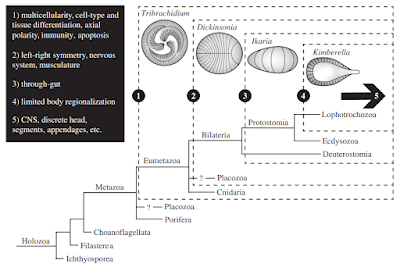
Scenario for the origins of development in bilaterians from [9]. Click to enlarge.

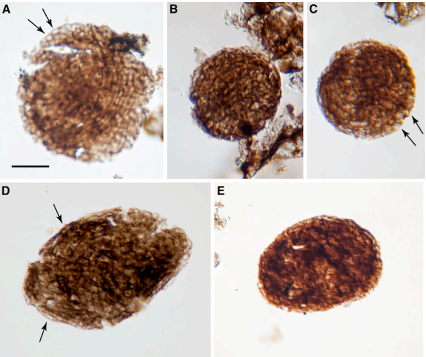
Bicellum brasieri is a 109 year old fossil holozoan that might provide the very earliest examples of modern embryos and embryogenesis [13]. Microfossils of Bicellum demonstrate morphogenesis in the form of cell-cell adhesion for different cell types, as well as differential layers of cells (driven by adhesion) which may be the precursors of tissue differentiation. This can be compared to the Doushantuo embryos from Precambrian China [14], and Caveasphera from 609 million years ago [15], which are perhaps the direct ancestors of Metazoan embryonic forms. These are the first examples of development proceeding within an enclosed space, enabled by cell adhesion similar to what is observed during gastrulation in modern embryos. Caveasphera in particular shows evidence of anatomical polarization (particularly polar aggregation), cell division events, and ingression [15]. This is informative but is not diagnostic of the Urmetazoan condition [16].
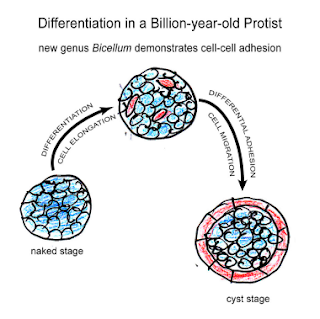
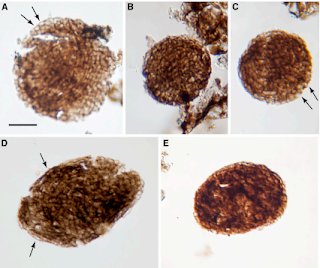
Graphical abstract and (top) palynological evidence of Bicellum brasieri (bottom) as shown in [13]. Epidermal layer (A and C), ellipsoid (D) and oblate (E) specimens Click to enlarge.

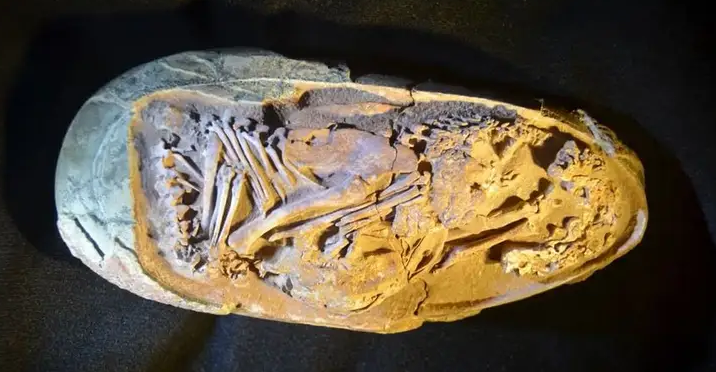
Since these pre-Cambrian explosion phenotypes are very simple, we can look to fossil evidence for much more complex embryo phenotypes in the late Cretaceous. Xing et.al [17] report on an in-ovo therapod dinosaur embryo, where the body is folded into an elongated egg. The authors are able to demonstrate how the fully formed head and legs are folded into different prehatching postures.


Graphical abstract showing developmental stages of Caveasphera [15]. Click to enlarge.

While the early phylogeny of nervous system origins is the very definition of a tangled tree [18], the first nervous systems coincide with the emergence of discrete body types in the Cambrian [19]. Brains emerged in part from the developmental toolkit responsible for patterning and segmentation [20]. This toolkit consists of genes and regulatory mechanisms that were co-opted for the development of excitable cells [21], synapses [22], and neuronal networks [2]. While the strongest evidence for early embryos only show evidence for bilaterian organization, radial symmetry is actually the basal condition for Metazoans [23]. Therefore, early embryos should yield at least two types of nervous system configurations that are observed in modern phenotypes: a centralized nervous system that converges in the head (the brains of bilaterians), and a distributed nervous system (the nerve nets of cnidarians). Centralized nervous systems originated from the mesoderm layer of triploblastic embryos, while distributed nervous systems are derived from the endoderm of diploblastic embryos. While there is a distinct literature on fossil radial embryos from China [24], there does not seem to be fossil evidence of germ layers formation and subsequent differentiation in any early embryos to date.
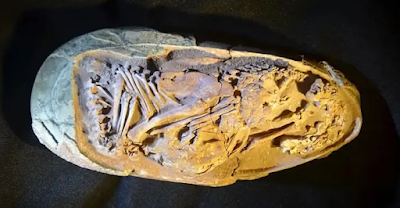
Image of Baby Yingliang (therapod dinosaur late-stage embryo) [17]. Click to enlarge.

But what happened before the earliest embryos (1000-650 million years ago)? What ecological conditions might have driven this innovation? One trigger may have been the great oxygenation event, which occurred in two stages: the first at 2.4 billion years ago, and the second at 950 million years ago. It was the second event that increased oxygen content to a level more resembling the present, and in turn drove diversification of distinct fungi, plants, and animals. It is of note that LECA (the last Eukaryotic common ancestor) lies well-beforehand [25]. The earliest embryos (or at least multicellular packings) might have resulted from selection pressure for retaining a low-oxygenation environment. But while these findings may lead to significant speculation, it seems that embryos are unique to Eukaryotic evolution, having no Bacterial or Archaebacterial counterpart despite evolving under the same conditions. It is most likely the interaction of genomic factors, developmental contingencies, and environmental conditions that ultimately lead to the emergence of embryos [26].


Phylogeny with evolution transitions from LUCA to embryos in plants and animals. Included are the two oxygenation events of Earth's history. Transitions derived from Refs [14, 27-31]. Click to enlarge.

References

[1] Hug, L.A. et.al (2016). A new view of the tree of life. Nature Microbiology, 1, 16048. 

[2] Valentine, J.W., Jablonski, D., and Erwin, D.H. (1999). Fossils, molecules and embryos: new perspectives on the Cambrian explosion. Development, 126, 851-859.

[3] Ou, Q., Vannier, J., Yang, X., Chen, A., Mai, H., Shu, D., Han, J., Fu, D., Wang, R., and Mayer, G. (2020). Evolutionary trade-off in reproduction of Cambrian arthropods. Science Advances, 6(18), doi:10.1126/sciadv.aaz3376.

[4] Xiao, S., Zhang, Y. and Knoll, A. H. (1998). Three-dimensional preservation of algae and animal embryos in a Neoproterozoic phosphorite. Nature, 391, 553-558.

[5] Erwin, D.H. (2020). Origin of animal bodyplans: a view from the regulatory genome. Development, 147, dev182899. 

complements. Nature, 442, 684–687. 

[7] Holland, P.W.H. (2015). Did homeobox gene duplications contribute to the Cambrian explosion? Zoological Letters, 1, 1. 

[8] Zhuravlev, A.Y. and Wood, R. (2020). Dynamic and synchronous changes in metazoan body size during the Cambrian Explosion. Scientific Reports, 10, 6784. 

[9] Evans, S.D., Droser, M.L., Erwin, D.H. (2021). Developmental processes in Ediacara macrofossils. Royal Society B, 288, 20203055.

[11] Finnerty, J.R., Pang, K., Burton, P., Paulson, D., and Martindale, M.Q. (2004). Origins of bilateral

[12] Brunet, T. and Booth, D.S. (2023). Cell polarity in the protist-to-animal transition. Current Topics in Developmental Biology, doi:10.1016/bs.ctdb.2023.03.001.

[13] Strother, P.K., Brasier, M.D., Wacey, D., Timpe, L., Saunders, M., and Wellman, C.H. (2021). A possible billion-year-old holozoan with differentiated multicellularity. Current Biology, 31, 1–8.

[14] First Embryos: Chen, J-Y., Bottjer, D.J., Li, G., Hadfield, M.G., Gao, F., Cameron, A.R., Zhang, C-Y., Xian, D-C., Tafforeau, P., Liao, X., and Yin, Z-J. (2009). Complex embryos displaying bilaterian characters from Precambrian Doushantuo phosphate deposits, Weng’an, Guizhou, China. PNAS, 106(45), 19056-19060.

[15] Yin, Z., Vargas, K., Cunningham, K., Bengtson, S., Zhu, M., Marone, F., and Donoghue, P. (2019). The Early Ediacaran Caveasphaera Foreshadows the Evolutionary Origin of Animal-like Embryology. Current Biology, 29, 4307–4314.

[16] Sebe-Pedros, A., Degnan, B.M., and Ruiz-Trillo, I. (2017). The origin of Metazoa: a unicellular perspective. Nature Reviews Genetics, 18, 498–512.

[17] Xing, L., Niu, K., Ma, W., Zelenitsky, D.K., Yang, T-R., and Brusatte, S.L. (2021). An exquisitely preserved in-ovo theropod dinosaur embryo sheds light on avian-like prehatching postures. iScience, 103516.

[18] Miller, G. (2009). On the Origin of The Nervous System. Science, 325(5936), 24-26.

[19] Erwin, D.H. (2020). Origin of animal bodyplans: a view from the regulatory genome. Development, 147, dev182899. 

[20] Hartenstein, V. and Stollewerk, A. (2015). The evolution of early neurogenesis. Developmental Cell, 32, 390–407.

[21] Moroz, L.L. and Kohn, A.B. (2016). Independent origins of neurons and synapses: insights from ctenophores. Royal Society B, 371, 20150041.

[22] Moroz, L.L. (2021). Multiple Origins of Neurons From Secretory Cells. Frontiers in Cell and Developmental Biology, 9, 669087. 

[23] Ghysen, A. (2003). The origin and evolution of the nervous system. International Journal of Developmental Biology, 47(7-8), 555-562.

[24] Xian, X-F., Zhang, H-Q., Liu, Y-H., and Zhang, Y-N. (2019). Diverse radial symmetry among the Cambrian Fortunian fossil embryos from northern Sichuan and southern Shaanxi provinces, South China. Palaeoworld, 28(3), 225-233.  AND  Chang, S., Clausen, S., Zhang, L., Feng, Q., Steiner, M., Bottjer, D.J., Zhang, Y., Shi, M. (2018). New probable cnidarian fossils from the lower Cambrian of the Three Gorges area, South China, and their ecological implications. Palaeogeography, Palaeoclimatology, Palaeoecology, 505, 150-166.

[25] McGrath, C. (2022). Highlight: Unraveling the Origins of LUCA and LECA on the Tree of Life. Genome Biology and Evolution, 14(6), evac072.

[26] Erwin, D.H. (2021). Developmental capacity and the early evolution of animals. Journal of the Geological Society, 178(5), jgs2020-245.

[27] Archaea: Gribaldo, S. and Brochier-Armanet, C. (2006). The Origin and Evolution of Archaea: a state of the art. Royal Society B, 361, 1007-1022.

[28] Great Oxygenation Event: Knoll, A.H.and Nowak, M.A. (2017). The Timetable of Evolution. Science Advances, 3, e1603076.  AND   Erwin, D.H. (2015). Early metazoan life: divergence, environment and ecology. Royal Society B, 370, 20150036.

[29] Fungi-Animal Common Ancestor: Phelps, C., Gburcik, V., Suslova, E., Dudek, P., Forafonov, F., Bot, N., MacLean, M., Fagan, R.J., and Picard, D. (2006). Fungi and animals may share a common ancestor to nuclear receptors. PNAS, 103(18), 7077–7081.

[30] LUCA: Dodd, MS, Papineau, D, Grenne, T et al. (5 more authors) (2017). Evidence for early life in Earth’s oldest hydrothermal vent precipitates. Nature, 543 (7643). pp. 60-64.  AND  Hassenkam, T., Andersson, M., Dalby, K., MacKensie, D.M.A., and Rosing, M.T. (2017). Elements of Eoarchean life trapped in mineral inclusions. Nature, 548, 78–81.

[31] Tree of Life: Feng, D-F., Cho, G., and Doolittle, R.F. (1997). Determining divergence times with a protein clock: Update and reevaluation. PNAS, 94, 13028-13033.

April 4, 2017

100 years of Growth and Form!


This year marks the 100th anniversary of "On Growth and Form" [1] by the biologist/ mathematician D'arcy Thompson. "On Growth and Form" has always been an intriguing book from both a historical and technical perspective [2]. This includes the integration of fields such as physics, developmental biology, and geometry. There is an entire website dedicated to the centennial, which demonstrates that his ideas are still useful today [3].

Four bony fish phenotypes related through evolution and transformed through phenotypic deformation. 

D'arcy Thompson provided an account of what we now call evo-devo [4] as a series of mathematical transformations. On the one hand, this provides a mathematical model for the static geometry of the developmental phenotype across species. On the other hand, Thompson provided few if any evolutionary, nor any genetic mechanisms, even in a time when both were becoming ascendant [5]. His physical approach to biological form and morphogenesis has not only been useful in biology, but also as inspiration for computational modeling approaches [6].


NOTES:
[1] Thompson, D.W. (1917). On Growth and Form. Cambridge University Press, Cambridge UK.

[2] Alicea, B. (2011). The Growth and Form of Pasta. Synthetic Daisies blog, October 11.

[3] Much of the contemporary innovation in this area is in the field of architecture. In modern evo-devo, it has taken a back seat to genetic manipulation. Given what we now know about evolution and genetics, there are some potentially interesting biological simulation to be done at the interface of regulatory mechanisms in development and phenotypic fitness based on biomechanical parameters.

[4] Arthur, W. (2006). D'Arcy Thompson and the theory of transformations. Nature Reviews Genetics, 7, 401-406.

[5] Deichmann, U. (2011). Early 20th-century research at the interfaces of genetics, development, and evolution: reflections on progress and dead ends. Developmental Biology, 357(1), 3-12.

[6] Kumar, S. and Bentley, P.J. (2003). On Growth, Form, and Computers. Elsevier, Amsterdam.

April 22, 2015

Earth Day 2015 Links

Happy Earth Day 2015, by way of Google's Doodle series.


Here are some Earth Day Doodles of years past. And here is an op-ed piece on how the transition from fossil fuels is closer than the pundits believe. Then, enjoy the pale blue dot.

Earth from a slightly different perspective. You are somewhere in "there". COURTESY: Planetary society.


May 20, 2014

Starstuff Squared, Rubik's Cubed

Welcome to the 250th Synthetic Daisies post! This post consists of three subthemes cross-posted from Tumbld Thoughts. The first is in honor of the Google Doodle for the 40th Anniversary of the Rubik's Cube, while the latter two are the supplemental readings for the tenth and eleventh episodes of the Cosmos reboot. 

I. Rubik's 3-D CSS Cubes


Today is the 40th anniversary of the Rubik's Cube. Aside from an invention that sold 350 million copies, Rubik's Cube is also an example of a permutation puzzle that contains an interesting problem related to group theory. The doodle itself is unique in that it utilizes a technology called CSS 3-D transforms [1]. Naturally, there is a Google Doodle.

[1] Edidin, R.   How Google Built Its 3-D Interactive Rubik’s Cube Doodle. May 19 (2014). Also check out the Chrome Cube Lab, which uses this technology to render interactive cube-based puzzles beyond Rubik's namesake.


II. All I Want For Christmas is an Electric Charge


Here are the supplemental readings for the tenth episode of the Cosmos reboot ("The Electric Boy"). Readings are organized by theme.


The Electric Boy and his Legacy:

History of the Christmas Lectures. The Royal Institution.

Cody, D.   Social Class. The Victorian Web. July 12 (2002).

Burgess, M.P.D.   Semiconductor History: Faraday to Shockley. Transistor History (2008).

Williams, A.T.   Faraday vs. Maxwell and Faraday and the Ether. Consciousness, Physics, and the Holographic Paradigm (2010).

Electromagnetic Spectrum. NASA Goddard Space Flight Center.


Frog Legs and Televisions:
Galvani's animal electricity experiments. Institute of Engineering and Technology.

Luigi Galvani (1737-1798). Center for Integrating Research + Learning, Magnet Lab, Florida State University.

Borgens, R.B., Vanable, J.W., and Jaffe, L.F.   Bioelectricity and regeneration. I. Initiation of frog limb regeneration by minute currents. Journal of Experimental Zoology, 200(3), 403–416 (1977).

Iconoscope. Wikipedia, March 20 (2014).

Philo Farnsworth (1906-1971), Electronic Television. Inventor of the Week Archive, Lemelson-MIT (1999).


Researching Faraday Cages and Electromagnetic Fields on Google is a sad statement on Internet culture:
Chandler, N.   How Faraday Cages Work. How Stuff Works.

Trottier, L.   A Growing Hysteria. Committee for Skeptical Inquiry, CFI. October (2009).


Inventions/Discoveries of the Electric Boy:
Faraday's Inventions. Michael Faraday's World.

Homopolar Generator, Wikipedia. April 1 (2014).

Electrolysis, Wikipedia. May 7 (2014).

Faraday Cage, Wikipedia. March 19 (2014).

Electric Motor, Wikipedia. May 10 (2014).

Static Electricity, Wikipedia. May 5 (2014).


III. Leaving Nothing but Footprints, but Still Living On.


Here are the supplemental readings for the eleventh installment of the Cosmos reboot ("The Immortals"). As usual, readings are organized by theme.


Entropy Is Not Immortality, Time Can Be Written Down:
Matson, J.   What Keeps Time Moving Forward? Blame It on the Big Bang. Scientific American, January 7 (2010).

Mlodinow, L. and Brun, T.A.   Relation between the psychological and thermodynamic arrows of time. Physical Review E, 89, 052102 (2014).


Jones D.L.   Aging and the germ line: where mortality and immortality meet. Stem Cell Reviews, 3(3), 192-200 (2007).

Barksdale, M.   10 Methods of Measuring Time. Discovery TV: Relativity and Time.

Origins of Writing Systems. AncientScripts.com.


Fun With the Origins of DNA:
Akst, J.   RNA World 2.0. The Scientist, March 1 (2014).

Moran, L.A.   Changing Ideas About the Origin of Life. Sandwalk blog, August 7 (2012).

Joshi, S.S.   Origin of Life: the Panspermia Theory. December 2 (2008).

Klyce, B.   Cosmic Ancestry. 

Saenz, A.   Venter creates first synthetic self-replicating bacteria from scratch. SingularityHub, May 20 (2010).


Moving Life (via Dispersal):
Levin, S.A., Muller-Landau, H.C., and Nathan, R.   The Ecology and Evolution of Seed Dispersal: a theoretical perspective. Annual Review of Ecology, Evolution, and Systematics, 34, 575-604 (2003).

Gronstal, A.   Space Rocks Could Reseed Life on Earth. Astrobiology Magazine, May 15 (2008).


Civilization is (not) Forever:
Chandler, G.   Desertification and Civilization. Saudi Aramco World, 58, 6 (2007).

Arbesman, S.   210 Reasons for the Fall of the Roman Empire. Social Dimension blog, June 26 (2013).

Kunzig, R.   Geoengineering: How to Cool Earth--At a Price. Scientific American, November (2008).

Duncan, R.C.   The Olduvai Theory: sliding towards a post-industrial Stone Age. Institute on Energy and Man, June 27 (1996).

Math Program Cracks Cause of Venus Hell Hole. Space Daily, March 21 (2001).

May 5, 2014

The Continuing Adventures of Starstuff

Here are the latest supplemental readings for the Cosmos reboot (as usual, cross-posted to Tumbld Thoughts). This post covers episodes 8 ("Sisters of the Sun", I) and 9 ("The Lost Worlds of Planet Earth", II). 

I. The Incredible Shape of Sunspots 


Here are the supplemental readings for the eighth installment of the Cosmos reboot ("Sisters of the Sun"). Readings are loosely organized by topic.


Observing the Night Sky:
Plait, P.   Black Skies, Smiling At Me. Bad Astronomy blog, April 23 (2014).

Klinkenborg, V.   Light Pollution. National Geographic, November (2008).

How to see the Big Dipper, and the famous stars Mizar and Alcor. EarthSky blog, March 24 (2013).

Emergence of a scientific field, in ways that were ahead of its time:
International Year of Astronomy - Annie Jump Cannon. The Museum of Flight.

Stellar Classification System. HyperPhysics.

Payne, C.   Stellar Atmospherics. Publications of the Astronomical Society of the Pacific, 38(221), 33. SAO/NASA Astrophysics Data System (ADS).

Biba, E.   Why the government should fund unpopular science. Popular Science, October 4 (2013).


Incredible Dynamics, Incredible Universe:
Mann, A.   Tatooine Times Two: Amateur Astronomers Find Planet in Four-Star System. Wired Science, October 15 (2012).

Planets with Two Suns Could Grow Black Trees. Space.com, April 18 (2011).

VLT Captures Stunning Stellar Explosion In 3D. RedOrbit, August 4 (2010).

The Great Eruption of Eta Carinae -- One of the Most Massive Stars in the Milky Way. Daily Galaxy blog, February 15 (2012).


But wait, there's more!
Steffens, M.   Australia's First Astronomers. Astronomy Basics, ABC Science.

Fuller, R.   The Kamilaroi and Euahalayi Emu in the Sky. Australian Indigenous Astronomy blog, March 31 (2014).

Ecology/Energy in Ecosystems. Chapter 14, Ecology. Wikibooks, October 22 (2013).


II. The More Things Change, the More They Are Subject to Uniformitarianism


Here are the supplemental readings for the ninth installment of the Cosmos reboot ("The Lost Worlds of Planet Earth"). A highly-selective (but still excellent) guided tour of the history of life on Earth. Readings are organized by theme.


Hundreds of Billions of _________ (your favorite noun here):
Carboniferous Period. National Geographic.

The Carboniferous. Palaeos.com.

Castro, J.   How do fossils form? LiveScience, June 26 (2013).

Permian-Triassic Extinction. PBS Evolution Library (2001).


The Great Dying. Science@NASA (2002).

Oskin, B.   Earth's Greatest Killer Finally Caught. LiveScience, December 12 (2013).


Plates, Oceans, and Deep Sea Surprises:


Oceans Atlas. HRW World Atlas (2006).

Atlantic Ocean Geophysical Map. National Geographic.


Pastore, R.   10 GIFs of Deep-Sea Creatures Encountering a Sub. Popular Science, May 2 (2014).

Villanueva, J.C.   Milankovitch Cycle. Universe Today, September 9 (2009).


April 24, 2014

New Directions in Space, Time, and Thought

Here is the latest news from the realm of Tumbld Thoughts. All features are interesting. In this post, we move from the latest episodes of Cosmos to new directions in economic value and the arXiv, to new directions in practicing research.

I. Making Amphibians Out Of Quarks and Other Tales of Scale


Here are the supplementary readings for Episode 6 of the Cosmos reboot, called “Deeper, Deeper Still”. These are organized by theme. I am not responsible for any groans my puns may cause.


(Episode) Origins…..
A sneak peek for this week. Daily Galaxy blog, April 12 (2014).

Ziggy Stardust and the Extra Dimensions (on Mars?):
Berkowitz, J.   The Stardust Revolution. Prometheus Books (2012).

Greene, B.   The Search for Hidden Dimensions. Richard Dawkins Foundation for Reason and Science. YouTube, May 17 (2010).


A human = 10^30 quarks?
Wolchover, N.   A Jewel at the Heart of Quantum Physics. Quanta Magazine, September 17 (2013).

Carroll, S.   Jaroslav Trnka on the Amplituhedron. Preposterous Universe blog, March 31 (2014).

Filmer, J.   New Discovery Simplifies Quantum Physics. From Quarks to Quasars blog, September 19 (2013).

Huang, C.   Scale of the Universe II. Scaleofuniverse.com.

Tardigrages and Angiosperms:
Stromberg, J.   How Does the Tiny Waterbear Survive in Outer Space?Smithsonian.com, September 11 (2012).

Nichols, P.B., Nelson, D.R., and Garey, J.R.   A family-level analysis of tardigrade phylogeny. Hydrobiologia, 558, 53-60 (2006).

Soltis, P., Soltis, D., and Edwards, C.   Angiosperms. Tree of Life (2005).


Plants Move Towards the Light and Make Food:
Wyatt, S.E. and Kiss, J.Z.   Plant tropisms: from Darwin to the International Space Station. American Journal of Botany, 100(1), 1-3 (2013).

Artificial Photosynthesis. Wikipedia, April 13 (2014).

Carbon is Versatile:
Buckminsterfullerene. Wikipedia, April 13 (2014).

Carbon Nanotube. Wikipedia, April 13 (2014).

Wall of Forever:

Tate, K.   How Gravitational Waves Work (Infographic). Space.com, March 17 (2014).


IMAGES:
Third from top: Book Cover, You are Stardust. Elin Kelsey and Soyeon Kim.

Fourth from top: Ichetucknee Springs, North Florida, USA.

Bottom Image: Evidence for Cosmic Inflation following the Big Bang, COURTESY:BICEP2 Group.

II. Clean Room Redux


Here are the supplemental readings for the seventh episode of the Cosmos reboot entitled "The Clean Room". A bit of a departure from the previous episodes in that the focus was on the social consequences of scientific findings. As usual, readings are thematic.


Meteors, Sediments, and Early Earth:
Scientists Building Asteroid Threat Early-Warning System. Space.com, February 20 (2013).

Diverging evolution of early Earth and Mars revealed by meteorites. The Daily Galaxy blog, April 17 (2014).

Appenzeller, T.   Early Earth. National Geographic, December (2006).


Clean Rooms and Isotopes:
Radioactive Decay: a sweet simulation of a half-life. AAAS Science NetLinks.

Radioactive Dating Game. PhET Interactive Simulations.

Lewington, R.   A virtual tour of Applied Materials' clean room. Applied Materials blog.


Chemophobia vs. Public Relations and the role of science:

How corporations corrupt science at the public's expense. Union of Concerned Scientists, Center for Science and Democracy.

Washburn, J.   Science's Worst Enemy: corporate funding. Discover Magazine, October (2007).

"Silent Spring" at 50. The credit, and the blame, it deserves. Big Think blog, June 19 (2012).

Lead poisoning and health. World Health Organization, Fact sheet #379. September (2013).

Needleman, H.L.   The removal of lead from gasoline: historical and personal reflections. Environmental Research, 84(1), 20-35 (2000).

III. Pushing the Boundaries of the arXiv


I guess I am literally pushing the boundaries of the arXiv. On Tuesday, March 25, I submitted a paper called "Contextual and Structural Representations of Market-mediated Economic Value". While they normally announce the paper at Midnight (GMT) the following weekday, this paper was not announced until two days later (Friday morning).


Usually, when a paper is delayed, it means there is an issue with classification. Ultimately, the paper was placed in the q-fin.GN category. Then, 12 days later, arXiv introduced two new categories: q-fin.EC (economics) and q-fin.MF (mathematical finance). While this could be a coincidence, I still like to think that my paper broke their system. Hopefully, it ends up breaks new ground and old paradigms as well.


IV. The New, Potentially Paradigm-busting Paper on the arXiv


How do we assign value to economic transactions? In my latest paper, now available at the arXiv, I approach this problem using a computational and evolutionary approach. "Contextual and Structural Representations of Market-mediated Economic Value" is my first paper in the "q-fin" category (1403.7021, q-fin.GN).


Culturally-mediated biological markets are used to model several aspect of object valuation. Contextual Geometric Structures (CGSs) [1] are used to model individual minds in an agent-based simulation. Read the paper to fully appreciate what this means. While it is a purely computational study, it might also be of interest to behavioral economists and evolutionary anthropologists.

Proceedings of Artificial Life, 13, 147-154 (2012).

IV. Orthogonal Research: slouching towards research enterprise


In lieu of a formal academic position, I am now publishing and conducting work under the affiliation "Orthogonal Research". This is (currently) a money-less start-up, focused on research in mathematical modeling and data analysis. Right now, this just involves myself. However, potential collaborators, co-PIs, and funders are welcome to contact me.

Things are a great deal more serious than this.

The Orthogonal Research Q1 activity report is now available. "Q1" refers to the first quarter of the calendar year, not financial.

Printfriendly