Showing posts with label cognition-thinking. Show all posts

October 24, 2024

OAWeek 2024: Intrinsic and Extrinsic Approaches to Open Access

This post is in celebration of Open Access (OA) Week 2024. The theme for this year is "Community over Commercialization". 

How do we incentivize people to adopt Open Access practices? We can take lessons from motivational Psychology to think about routes to better practice. Before doing so, we need to consider the current (and often sorry state) of open access.

It could be argued that in some important ways, Open Access has failed. The system of access to academic goods as currently structured is built on significant benefits to publishers and costs to libraries and authors. This benefit has been accrued by publishers due to reputational benefits: being published in Nature, Science, or Cell is highly prestigious. Yet the benefits of this prestige are necessarily limited to a few groups with lots of resources. And the beneficial attributes of open access have been captured by commercial entities. Similar problems plague the open-source community, a shift to the open ethos is the only way out.  

The different types of open access also play different roles in the marketplace of academic goods. Green open access, or self-archiving artifacts, are community goods. While this can be susceptible to the tragedy of the commons, proper social investment can ameliorate maintenance and growth imperatives. This is often seen as the highest standard for open access but requires community investment. Building a sustainable infrastructure of preprints, open peer review, and overlay journals has been elusive.

The Economic Benefits and Costs of Different Colored Access


Black open access using tools such as Sci-Hub is considered piracy (hence the "black" label). From an economic perspective, piracy is symptomatic of a dysfunctional market. Indeed, part of open access' failure is due to the dominant position of publishers and their own economic imperatives. In fact, black open access can be considered a rational response to closing access to article in a research culture of sharing and finding alternate routes to success [1-3]. 

To focus more on the publisher's advantage, and the failure point of open access more generally, is the current state of Gold, Diamond, and Platinum open access. Gold open access involves payment of an APC (Article Processing Charges) fee to the publisher. This often reduces the burdens on libraries, as they previously paid excessive subscription fees. This is because APCs actually increase the burden on individual authors, with disappointing results on the prestige economy. Without market power for the authors (or home institutions), there is no incentive to build Diamond and Platinum access systems. In such systems, no APC fee is paid, and we get the prestige that people seek. One barrier to this is shifting the burden back to publishers, but with proper management of community resources it is the least bad option.

Up to this point, I have been speaking in economically coded language. Without thinking about various motivations, however, we cannot fully understand ways to move forward. Let's think about various intrinsic/extrinsic motivations of authors and their institutions to reclaim open access. Intrinsic motivations are properties of individual cognition, while extrinsic motivations are things that motivate individual behaviors from the outside world.

Intrinsic motivations

There are many intrinsic motivations that drive acceptance and adoption of open access. But there are many that do not, and these motivations often come into tension. Positive drivers include striving for a better community, an imperative for sharing results with the community, the ability to provide different platforms for scientific communication (datasets, hypotheses, theory, out-of-scope studies), and recognition for unsung components of the scientific process (such as technical reports or negative results). Negative drivers include a need to satiate cultural traditions, an inability to convey prestige through open means, a conflation of open access with fraud and low-quality work, and an inability to meet the quality needed to do open access successfully.  

Extrinsic motivations

The multitude extrinsic motivations include institutional support, the need for career promotion, community rewards and prestige, the pressure for cost savings, and technological ease of adoption. These can be a mix of positive and negative drivers that make adoption of open access hard to justify. Interactions with open-source software can also drive open access adoption, as the commitment needed to develop shared data and code can be easily extended to other academic artifacts.

What is the path forward? 

Sometimes considering motivations are not enough, and the community is much pettier and more irrational than we like to admit. It is worth thinking about eLife's model in open peer review, which in part lead to a backlash against the editorial staff [4, 5] by less sympathetic members of the scientific community (and barely-disguised corporate interests). Part of this is a disagreement about open strategies, but this is also about the gatekeeping nature the scientific community itself. The eLife model allows for papers to be preprinted, and then peer reviewed. The paper remains live on eLife's website even if the reviews recommend rejection (although the rejection is noted) [6, 7]. This is not novel amongst open peer review platforms but has rankled the more hierarchically oriented members of the scientific community. Perhaps we need to also consider "irrational management strategies", or what intrinsic motivations drive decisions that favor obsolete conventions.


References:

[1] Melvin et.al (2020). Communicating and disseminating research findings to study participants: Formative assessment of participant and researcher expectations and preferences. Journal of Clinical and Translational Science, 4(3), 233–242.

[2] Casci and Adams (2020). Research Culture: Setting the right tone. eLife, 9, e55543.

[3] Nosek et.al (2015). Promoting an open research culture. Science, 348(6242), 1422-1425.

[4] eLife latest in string of major journals put on hold from Web of Science. RetractionWatch. https://retractionwatch.com/2024/10/24/elife-latest-in-string-of-major-journals-put-on-hold-from-web-of-science/

[5] Abbot (2023). Strife at eLife: inside a journal’s quest to upend science publishing. Nature News, March 17. https://www.nature.com/articles/d41586-023-00831-6

[6] F1000 Staff (2022). Open peer review: establishing quality. March 7.  https://www.f1000.com/blog/peer-review-establishing-quality

[7] McCallum et.al (2021). OpenReview NeurIPS 2021 Summary Report. https://docs.openreview.net/reports/conferences/openreview-neurips-2021-summary-report

August 24, 2021

OREL Medium: Trajectories in Cognitive Science Session @ CogSci 2021


This content was originally posted to the Orthogonal Research and Education Lab blog on July 30.

Congratulations to Jesse Parent, Avery Lim, Bradly Alicea, and Anusha Sharma for heading up the “Trajectories in Cognitive Science” discussion group, held during the CogSci 2021  conference. The event happened in six parts (which we will recap) and is now on YouTube. We are also archiving the slides and reference list on the Open Science Framework (in progress).

Part I: Frontier Map and Cognitive Futures. Presenter: Jesse Parent.

The first part of the session involved an overview of Frontier Maps and the role of maps and visualizations in understanding how ideas form fields of study. Frontier Maps also enable casual learners to get an intellectual grasp on a certain area of study by learning its history and current trends.

Part II: Adjacent Futures. Presenter: Bradly Alicea.

The second talk was given by Bradly Alicea, and involved introducing the idea of Adjacent Futures, which is based on the notion of the adjacent possible. Our focus was on both the possibilities that define scientific discovery and interdisciplinary exploration and the factors (sometimes quite practical) that block combinatorial discovery that often define the boundaries of a given field.

Part III: The Place of Development in the History of CogSci. Presenters: Jesse Parent and Anusha Sharma.

This session (brought to us by Jesse Parent and Anusha Sharma) covered the rich history of developmental approaches in Cognitive Science, and how development has served as an alternative to the concept of “static adult minds”. The presentation was an in-depth presentation of the review article “The Place of Development in the History of Psychology and Cognitive Science” by Gabriella Airenti (Frontiers in Psychology, 10, 895). In the session, we explored the foundational concepts of Piaget as well as longstanding debates such as nature vs. nurture and representationalism vs. brain function.

Part IV: Neurodiversity and Cognitive Science. Presenter: Jesse Parent.

The fourth presentation was also by Jesse Parent, and covered the role of Neurodiversity in Cognitive Science. This was a short review of a book called “Neurodiversity Studies: a new critical paradigm”. Neurodiversity covers a number of alternative frameworks for understanding human cognition, including but not limited to queer, feminist, and critical race perspectives. Such perspectives contribute not only to the diversity of views in the field, but also lead to novel intellectual trajectories.

Part V: Trajectories of Interest in Developmental Psychobiology. Presenter: Avery Lim.

Avery Lim presented on a number of possible trajectories for developmental psychobiology considered broadly. This possibility space (discussed in Part II) includes building off of the study of phenomenology such as developmental critical periods or computational models of psychophysiology. A number of open questions were also posed that motivated our discussions in Part VI.

Part VI: Open Discussion!

If you are interested in discussing these topics further, you might be interested in joining the Orthogonal Lab Slack or the Computational Critical Periods Discord. You can also catch Saturday Morning NeuroSim weekly on YouTube, or get in contact to get on our mailing list and join in person.

June 4, 2021

Dispatches from the Emergent Interaction Workshop

 This content has been cross-posted at the Orthogonal Lab Medium.


Last month, the Orthogonal Lab was represented at the Emergent Interaction Workshop (part of SIGCHI 2021). We contributed a paper titled “Allostasis Machines: a model for understanding internal states and technological environments”, with a companion presentation now on YouTube. Thanks go to Bradly Alicea, Daniela Cialfi, Anson Lim, and Jesse Parent for their contribution. We are planning an expanded version of this work with Rishabh Chakraborty that will demonstrate Allostasis Machines as a Reinforcement Learning implementation.

The subtitle of this workshop was “Complexity, Dynamics, and Enaction in HCI”. Therefore, the focus was on advancing measurement and theory, in addition to better characterize complexity in the field of Human-Computer Interaction. The four-hour long session was summarized in our weekly meeting on May 22. I have also provided supplemental readings in four workshop-related categories at the bottom of this post.

Overview of the Emergent Interaction Miro board.

There were six other papers made available before the session. Two of the most interesting to the Orthogonal Lab group are “Fields of Affordances and Human Computer Interaction” by Jelle Bruineberg and “Simulating Social Acceptability With Agent-based Modeling” by Alarith Uhde and Marc Hassenzahl.

The Emergent Interaction utilized Zoom, Slack, and a Miro board to enable discussion during the session. Check out the overview paper titled “Emergent Interaction: Complexity, Dynamics, and Enaction in HCI” for more information.

Testing, 1, 2, Emergent T-shirt….

There were a number of interesting and innovative topics discussed in the workshop. Dynamical approaches came up several times, along with topics such as multifractality, attractor analysis, and co-evolutionary experimental design. For more information regarding the first two topics, check out Alan Dix’s blog on Making Sense of Quantitative Data, and Dan Bennett’s preprint “Multifractal Mice: Measuring Task Engagement and Readiness-to-hand via Hand Movement”.

Tom Froese presented on his Enactive Artificial Intelligence and HCI work. His Google Scholar profile features some really interesting work that cuts across the worlds of Artificial Life, Cybernetics, and Cognitive Science, but his workshop topic was how modern Machine Learning approaches are insufficiently embodied. I have posted references to two of his key works (workshop-wise) in the Further Readings section of this post.

Later, Parisa Eslambolchilar presented on first-order closed-loop feedback taking the form of sensor-based human interaction loops. She reviewed some of the things she developed in her Doctoral dissertation, then lead us into her more recent work. Learn more by reading “A Model-Based Approach to Analysis and Calibration of Sensor-based Human Interaction Loops”.

Then, Vassilis Kostakos discussed his work on modeling interactions between technology users (or users and interfaces) as a complex system. He utilized the “lynx-hare” predator-prey analogy, inspired by Lotka-Volterra co-evolutionary dynamics. Read more in this paper published last year in Human-Computer Interaction: “Modeling interaction as a complex system”.

Emergent Interaction is now on Twitter! Give them a follow to join the discussion.

Further Reading: Measurement techniques.

Rebout, N., Lone, J-C., De Marco, A., Cozzolino, R., Lemasson, A., and Thierry, B. (2021). Measuring complexity in organisms and organizations. Royal Society Open Science, 8, 200895.

Zhou, Q., Chua, C-C., Knibbe, J., Goncalves, J., and Velloso, E. (2021). Dance and Choreography in HCI: A Two-Decade RetrospectiveProceedings of CHI, 262, 1–14. Video

Further Reading: Enactive Approaches to Artificial Systems.

Froese, T. and Ziemke, T. (2009). Enactive artificial intelligence: Investigating the systemic organization of life and mindArtificial Intelligence, 173, 466–500.

Froese, T., McGann, M., Bigge, W., Spiers, A., and Seth, A.K. (2012). The Enactive Torch: A New Tool for the Science of PerceptionIEEE Transactions on Haptics, 5(4), 365–375.

Further Reading: Agent-based Modeling approaches.

Bonabeau, E. (2002). Agent-based modeling: Methods and techniques for
simulating human systems
PNAS, 99(3), 7280–7287.

Grimm, V., Revilla, E., Berger, U., Jeltsch, F., Mooij, W.M., Railsback, S.F., Thulke, H-H., Weiner, J., Wiegand, T., and DeAngelis, D.L. (2005).
Pattern-Oriented Modeling of Agent-Based Complex Systems: Lessons from EcologyScience, 310, 987.

Further Reading: Criticalities and Characterizing Systems.

Dotov, D.G., Nie, L., and Chemero, A. (2010). A Demonstration of the Transition from Ready-to-Hand to Unready-to-HandPLoS One, 5(3), e9433.

Kelso, J.A.S. (2021). Unifying Large-and Small-Scale Theories of CoordinationEntropy, 23(5), 537.

March 30, 2021

The World of Physical Intelligence

As part of the Embodied Intelligence workshop this past week, I saw a presentation by Metin Sitti of the Max Planck Institute for Intelligent Systems on the emerging paradigm of Physical Intelligence. What is Physical Intelligence? It is the intelligent behavior exhibited by motion and takes into account a morphology (embodiment) and action at multiple scales of spatial organization. The talk was wonderful and walked through a number of empirical studies involving both living and non-living systems. I will leave it up to the reader to appreciate all of the points raised in this talk.

Physical Intelligence as an emerging idea.

While Physical Intelligence is not a common paradigm, the general idea is actually not new. Other people have proposed very similar frameworks over the past 15 years or so, including yours truly. Physical Intelligence involves some form of motor or movement behavior, which is generated by an embodied agent, that in turn interacts with the physical environment that can be defined by features such as inertial and gravitational forces, surface textures, and even light energy. 

Physical stimuli for soft robots or other autonomous agents from Figure 1 in Shen et.al, Journal of Materials Chemistry B, 8, 8972-8991 (2020).

At its most human-centric, physical intelligence can be just another word for embodied intelligence, which is where the body shapes and determines what is experienced by the nervous system. In cases where the behaving agent has no nervous system, the body geometry shapes the agent's behavioral output. This is true both in cases of adaptive (intentional) behavior and reactive behavior. In some cases, physical intelligence is identical to Neuromechanics. In other cases, it resembles a range of fields, from Biophysics to Embodied Robotics. The important contribution of the Physical Intelligence paradigm is the principles that guide this diverse topical terrain. Both my talk and Metin's talk provide some of these potential principles, and Scott Grafton's book provides a few more.


One human-centric interpretation of Physical Intelligence (by Scott Grafton).

Metin brings up the example of the Strandbeest, which is a kinetic sculpture with no nervous system or centralized control. This is an example of a purely reactive system that also generates seemingly intelligent behavior. Closer to the human experience is the Passive Dynamic Walker, which produces human-like bipedalism without a central nervous system. This is the essence of the physical: a particular physical configuration can exhibit reactive behavior independently of a central controller.

While serving as part of the peripheral nervous system, and in fact being controlled by a central nervous system, muscles can also play a key role in physical intelligence. While muscle cells can be spontaneously active without being inputs by motor neurons, there is a elaborate coordination between the central nervous system and muscular control. Muscular control can produce both very fast and very slow adaptive movements. In addition, the overall shape of a body in relation to its muscles can constrain the behavior of the agent in question.

The main takeaway is that the brain, body, and environment all work interdependently to shape the behavior that emerges from this complex system. Even in cases where there is no brain (or neural network), the interactions between body and the environment are enough to generate reactive behaviors that appear to be intelligent. This is true for both individual morphologies and the collective behavior of many agents (e.g. swarm intelligence). In fact, the brain can be supplanted by control mechanisms that regulate the conformity and response to physical forces in the environment. Future work should focus on the differences between "neural" and "physical" behavior, as well as the necessity and sufficiency of each component in the triad.

A diagrammatic example of this relationship (with a brain in the feedback loop) from Chiel and BeerTrends in Neuroscience, 20(12), P553-P557.

In conclusion, DARPA has also engaged in the idea of physical intelligence, and there was a proposer's conference in 2009. This version of Physical Intelligence has a strong cybernetics flavor, particularly in incorporating the EGRT (Every Good Regulator Theorem) into the mix.


Cybernetics of the firm (deemphasizing the role of individual morphology). COURTESY: New World Encyclopedia.


February 28, 2021

The Way of The Polymath

This content is cross-posted to the Orthogonal Research and Education Lab Medium.

What constitutes a polymath, and why are they so rare? Another way to ask this question is why are there so few foxes relative to hedgehogs? The occasional hyper-specialist would have you believe the term "polymath" is an epithet. However, there are a number of skills that the polymath possesses that translate into an advantage for advancing both theory and fundamental knowledge. Aside from the mastery of multiple intellectual areas, the most important of these is the ability to synthesize information from a number of sources. The advent of digital scholarship may enable this ability in the foxes among us [1].

One depiction (late 19th, early 20th century) of a polymath.

Back in 2015, Nature Careers released a list of recommendations to combat the hyper-specialist tendencies of PhD programs [2], but many of these are simply window-dressing. One view is that improving the state of interdisciplinary thinking is to improve the infrastructure for collaboration and disseminating big ideas. However, a more fundamental (and harder-to- implement) change that can be made is to reconfigure the epistemic landscape of science [3]. One aspect of this indeed involves the training of scientific generalists, but generalist training does not equate polymathism.


The other factor involves the potential zero-sum nature of generalized knowledge [4]. There is a constant tradeoff between deep expertise in one area versus more shallow expertise in a number of areas simultaneously. Society tends to reward deep expertise, and synthesis is rather expensive knowledge-wise. In any case, there is a game-theoretic interpretation of this scenario, but that is a topic for another post.  


Here is a semi-annotated reading list on singular (but multidisciplinary) academic activity:

Hossenfelder, S.   The loneliness of my notepad. Backreaction blog, July 8 (2015).


Issacson, W.   Myth of the Lone Genius. Aspen Journal of Ideas, July 24 (2015). 

These articles critically examine the myth of the lone genius. The first article points out that tools enabling collaboration (e.g. internet, large-scale consortia) are finally starting to bear fruit. Proportion of single-author papers has gone down over last 20-30 years, but that does not mean lone efforts are in absolute decline. In fact, "isolation" is a myth, given the social networks and information-sharing culture in academia.


Bateman, T.S. and Hess, A.M.   Different personal propensities among scientists relate to deeper vs. broader knowledge contributions. PNAS, 112(12), 3653-3658. (2015).


Kirkegaard, E.   Personality correlates of breadth vs. depth of research scholarship. Project Polymath blog, March 6 (2015).

* relates style of scientific investigation to type of contributions (specialized studies vs. broad interdisciplinary synthesis) made by scientists. Survey methodology does not assume that contributions can be both deep and broad, despite setting this up as a dichotomy. Is "deeper" vs. "broader" a major dichotomy in scientific exploration.

* suggests that the difference between scientific generalists and specialists is epistemic, not economic as traditionally assumed (e.g. a certain strategy is more or less risky).

* views differences in types of scientists (e.g. polymathy) as a matter of personality, not epistemic bias.


Palla, G., Tibely, G., Mones, E., Pollner, P., and Vicsek, T.   Hierarchical networks of scientific journals. arXiv, 1506.05661 (2015).

Presents a hierarchical network analysis of scientific journals and their relevance to measuring influence and the diffusion of ideas in specific scientific fields.


Muldoon, R. and Weisberg, M.  Robustness and idealization in models of cognitive labor. Synthese, 183, 161-174 (2011).

* introduce us to an economic optimization model called the marginal contribution/reward (MCR).

* motivation of individuals or groups of scientists is accomplished either through self-interest or epistemic norms.

* MCR assumes that cognitive labor can be optimally distributed across collaborations to solve hard problems. The problem is stated as a constrained maximization of "success" and "return". Model does not provide good approximations of success, return, or epistemic norms, not does it distinguish amongst different scientific skill-sets (generalists vs. specialists vs. hyper-specialists).


Sarma, G.P.   Should we train scientific generalists? arXiv, 1410.4422 (2014).

* how to introduce students to a vocabulary of multiple disciplines, and how this would encourage research breadth.


alexarje   Disciplinarities: intra, cross, multi, inter, trans. Alexander Refsum Jensenius blog, March 12. (2012).


NOTES:
[1] Alicea, B.   "Academic Connectivity and the Future of Scientific Ideas". Synthetic Daisies blog, September 9 (2011).

[2] Nurse, P.   To build a scientist. Nature, 523, 371-373 (2015).

[3] Weisberg, M. and Muldoon, R.   Epistemic Landscapes and the Division of Cognitive Labor. Philosophy of Science, 76(2), 225-252 (2009).

[4] Downey, G.   Interdisciplinarity, sub-disciplinarity, and inter-topicality. Uncovering Information Labor blog, March 31 (2006).

February 12, 2021

Assorted Darwin Day Content


For this year's Darwin Day post, I will highlight a number of items I have recently run across on Twitter. Some of these have been retweeted on the Orthogonal Research and Education Lab Twitter feed, other materials are related to discussions in our research group meetings.

To start things off, I will draw your attention to a new special issue of Royal Society of London B called "Basal cognition: multicellularity, neurons and the cognitive lens" that is worth checking out. The term "basal" refers to evolutionary origins in the context of phylogeny (the tree of life)


The new paper on elementary nervous systems in Royal Society B (click to enlarge, figure from paper). COURTESY: Detlev Arendt.

A pointer to the Darwin Online repository.

In terms of old drawings and other archival materials, check out the Darwin Online project. This is a nice repository of Darwin-related historical and scientific works. This resource contains books, personal correspondence, and published materials. Speaking of history, let's turn to the deep history of life.....

A billion years of continental drift as an animated gif. Click to enlarge.

This next feature is a new paper on a billion years of plate tectonic dynamics: "Extending full-plate tectonic models into deep time: Linking the Neoproterozoic and the Phanerozoic" by Mike Tetley and colleagues. Now published in Earth Science Reviews, it is something we recently discussed in the weekly DevoWorm group meeting.

Following up on the DevoWorm discussion, which was about mapping the continental drift animation to the most basal branches of the tree of life, is an attempt to map Mammalian phylogeny [1] to continental drift over the past 225 million years. This was created by Carlos E. Alvarez. The numbers on the maps (top) correspond to the numbered clades (subtrees - bottom). This topic deserves a deeper dive into the latest Phylogeography research [2], which may be the subject of a future blog spot.

An attempt at matching up the tree of life with continental drift (click to enlarge). COURTESY: Carlos E. Alvarez

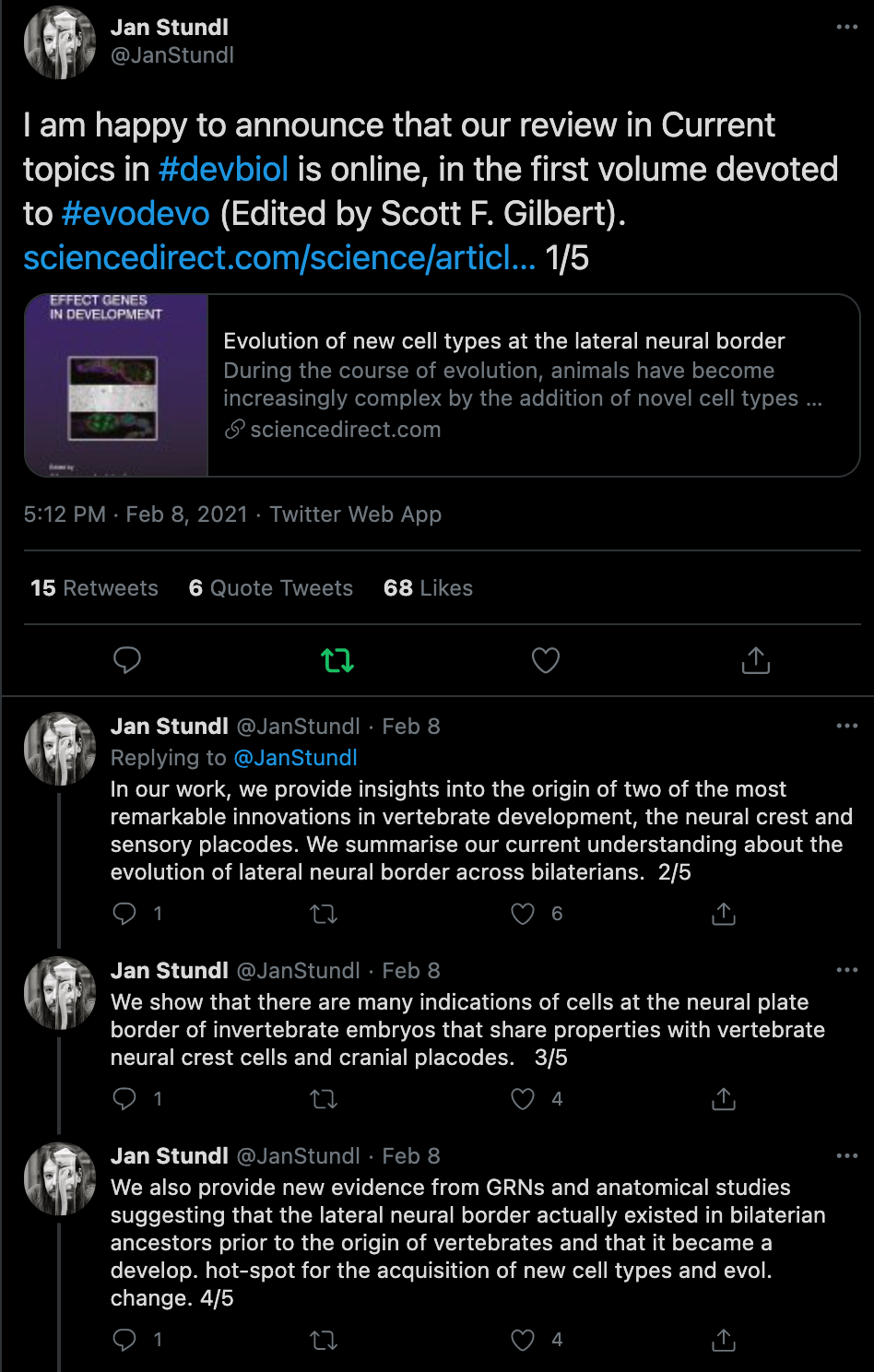
The next feature is a new paper on evolution of development (evo-devo) in nervous system anatomy called "Evolution of new cell types at the lateral neural border", now published in Current Topics in Developmental Biology. This study even uses converging evidence from genetic regulatory networks and anatomy to demonstrate common mechanisms shared between invertebrates and vertebrates.

A new paper on the evolution of new neuronal cell types (click to enlarge). COURTESY: Jan Stundl (Caltech).

Not only is this Darwin Day, but also the 50th anniversary of a Nature paper by Kimura and Ohta [3] on the Neutral Theory of Molecular Evolution. Neutral Theory postulates that most biological variation is expressed in selectively neutral genes, and so is random in nature [4]. This stands in opposition to the selectionist perspective of evolutionary change [5, 6].


Fully-tweetable neutral theory of evolution. COURTESY: Andrew J. Crawford.

Finally, and returning to neuroevolution, there are several items of interest from the laboratory of Cassandra Extavour. The first is a talk at the Society of Integrative and Comparative Biology meeting on the evo-devo-eco-neuro-biology of Drosophila learning and memory. For more evo-devo work from Dr. Extavour's lab, check out this recent work (with open data) on insect size and shape [7, 8].

Original artwork from SICB Twitter Account, commentary from Ken A. Field.

Hand-drawn notes on the SICB plenary talk. COURTESY: Dr. Ajna Rivera.

NOTES:

[1] Foley N.M., Springer M.S. and Teeling E.C. (2016). Mammal madness: is the mammal tree of life not yet resolved? Philosophical Transactions of the Royal Society B, 37120150140. doi:10.1098/ rstb.2015.0140.

[2] Avise, J.C. (2000). Phylogeography: the history and formation of species. Harvard University Press, Cambridge, MA.

[3] Kimura, M. and Ohta, T. (1971). Protein Polymorphism as a Phase of Molecular Evolution. Nature, 229, 467–469.

[4] Kimura, M. (1983). The Neutral Theory of Molecular Evolution. Cambridge University Press, Cambridge, UK.

[5] Nei, M. (2005). Selectionism and Neutralism in Molecular Evolution. Molecular Biology and Evolution, 22(12), 2318–2342. doi:10.1093/molbev/msi242.

[6] There are other critiques of selectionism from other perspectives. Here is one in the area of brain function: Fernando, C., Szathmary, E., and Husbands, P. (2012). Selectionist and Evolutionary Approaches to Brain Function: A Critical Appraisal. Frontiers in Computational Neuroscience, 6, 24. doi:10.3389/ fncom.2012.00024.

[7] Church, S.H., Donoughe, S., de Medeiros, B.A.S., and Extavour, C.G. (2019). Insect egg size and shape evolve with ecology but not developmental rate. Nature, 571, 58–62.

[8] Church, S.H., Donoughe, S., de Medeiros, B.A.S., and Extavour, C.G. (2019). A dataset of egg size and shape from more than 6,700 insect species. Scientific Data, 6, 104.

November 18, 2020

Presentations at Neuromatch (NM)3


Neuromatch 3 (NM3) happened a few weeks ago in virtual space, and it was great! There were hundreds of presentations over five days (October 26-30), many of them already archived on YouTube. This version of Neuromatch took the place of Society for Neuroscience (SfN), which was cancelled due to COVID. In this sense, Neuromatch is proving itself to be an improvement on the legacy conference. Between my two research groups (Representational Brains and Phenotypes and DevoWorm), we had five presentations submitted to NM3. Let's go through them one by one.


This presentation was by Krishna Katyal and myself. Krishna is a regular contributor to the DevoWorm group. This presentation demonstrates several contrasts between Biological and Artificial Neural Networks, and how level of abstraction, network structure, and energetics all play a role in distinguishing the information-processing marvels known as biological brains.


Thinking more along the lines of biological development, the next presentation features work done in the Representational Brains and Phenotypes Group. Taking a developmental approach to the classic Braitenberg Vehicle, we demonstrate how embodied developmental principles can be used to shape and guide networks for learning. Topics such as developmental contingency and the difference between morphogenesis and learning during the development of an artificial nervous system were also discussed.


Are the advantages of cognitive information processing limited to organisms with a brain? This seems like a strange question, but can actually help us understand what a brain does and why it is important for coordinating the behavior of complex multicellular systems. In this presentation, which includes contributors to both the Representational Brains and Phenotypes and DevoWorm groups, we reconsider a model of Diatom movement as cognitive information processing. We also propose a series of potential scenarios in which this information processing occurs as well as Psychophysical-like measures to quantify these phenomena.


This abstract was submitted by Jesse Parent and Anson Lim, two regular contributors to the Orthogonal Research and Education Lab. Jesse is also a group leader and community manager in the lab. While they were not able to present during the scheduled time, they continue to work on this topic under the new and emerging Cognition Futures project.


The final talk was by Akshara Gopi (a regular contributor to the Orthogonal Research and Education Lab), along with myself and Ashwin Irungovel. This presentation was on convergence insufficiency in human vision, a topical specialty of Akshara and Ashwin. My contribution was to propose an agent-based model for this phenomenon. 

Check out all of the great talks at NM3, including one by Rishabh Chakrabarty (regular research contributor to the Orthogonal Lab) and his co-author called "Seeing through the Mind’s Eye: reconstruction of the visual stimuli using 3D Generative-Adversarial Modeling". This intriguingly titled talk features research that combines Neuroimaging data with Deep Learning.

If you are interested in these topics and want to be involved in this research, join us at our weekly research meetings (Saturday Morning NeuroSim and DevoWorm group), or watch them on YouTube! I also invite you to join the Orthogonal Research and Education Lab Slack or OpenWorm Slack (DevoWorm) for continued discussion. Hope to see everyone at Neuromatch 4!

Printfriendly