Showing posts with label lectures-Michigan-State-University. Show all posts

November 11, 2013

New Work on CGSs: ritual and incorporative modeling

Here are two short features (something I am calling social media posters) that I debuted on Tumbld Thoughts. Think of this as posting entries from your laboratory notebook (one of several, in my case) to social media. In this case, each entry is further development of the Contextual Geometric Structures idea. The first poster is on the exaptation of rituals from a mathematical modeling perspective, using Halloween as a seasonally-appropriate example. The second poster is on something called incorporative modeling, using my "return from Robotistan" [1] as an example.

I. Seasonally-appropriate Cultural Exaptation


Why do rituals change over time? Why do they resemble weird things? And why do people believe even weirder things about these weird things? Here is a demonstration of something I am calling ritual modeling, using Halloween as an example. 

Some elements (particularly the forgetting/ decay measurements) of this are drawn from [2]. Additional process modeling and graph with pseudo-data were done to demonstrate this idea.


II. Returning from Robotistan


Here is a counterpart to my recent post on ritual modeling. To place this in context, here are a few readings on the highly predictive parts of human behavior. In [3], the analysis of easily- tracked human behaviors (such as mobility) can lead to highly predictable patterns. In [4], Sandy Pentland from MIT discusses how big data (databases of internet behavior) allow us to predict human behavior independently of morals and values. This has the effect of uncovering behaviors (using machine learning techniques) that people are usually not straightforward about in their language or public persona.

These types of analyses are useful both in terms of understanding aggregate cultural trends and the construction of crude behavioral models. So while such approaches are highly successful at characterizing well-known behaviors, they do not consider how new information is incorporated into behavioral schemes, especially those which are not highly predictive to begin with. This requires a more purely computational (e.g. simulation-based) approach.


To address this, I introduce something called an incorporative model, which draws from earlier work on Contextual Geometric Structures (CGSs). CGSs [2] are a hybrid soft classifier/fluid dynamics-inspired computational model of cultural behavior (e.g. culturally-conditioned collective behaviors). The slides show how observations are incorporated into such models, and how this new information is shared across a population of agents.


Before we end, the video for my lecture to the BEACON Center in May is now available on the BEACON Center YouTube channel. The second part discusses the application of CGSs to understanding the evolution and dynamics of economic value.

NOTES:

[1] For more musings from my trip, please see: Alicea, B.   Fear and Loathing in Robotistan. Synthetic Daisies blog, August 20 (2013).

[2] Alicea, B.   Contextual Geometric Structures: modeling the fundamental components of cultural behavior. Proceedings of Artificial Life, 13, 147-154 (2012).

[3] Song, C., Qu, Z., Blumm, N., Barabasi, A-L.   Limits of Predictability in Human Mobility. Science, 327, 1218-1021 (2010).

[4] Pentland, S.   Predicting Customers' (Unedited) Behavior. Harvard Business Review, September 19 (2012).

May 15, 2013

Lecture to BEACON Center, Michigan State

On May 17th (Friday) at 3:30pm (EST), I will be giving a lecture entitled "Adventures in Quasi-Evolution" [1] to the BEACON Center [2]. The audience is Thrust Group 1 (Genomes, Networks, and Evolvability).


The first half of my talk will be on computational models of cellular reprogramming (e.g. evolutionary modulus, or the engineering on the remnants of evolutionary and developmental variation). The second half is some emerging work I am doing on the cultural evolution of economic value (e.g. evolutionary through the looking glass, or how evolutionary models [3] may explain current economic puzzles).


NOTES:

[1] "Adventures in Quasi-Evolution". Figshare, doi:10.6084/m9.figshare.701463 (2013). I define quasi-evolution as "changes over time not due to reproductive fitness or generational inheritance".

[2] For those who are unfamiliar, the BEACON Center (an NSF-funded center) is a multi-disciplinary, multi-University group interested in the intersection of biology and engineering with relevance to evolution. Catch the lecture at one of these locations:

Michigan State University: Biomedical and Physical Sciences Building, Room 1441 (BEACON seminar room), 3:30pm.

North Carolina A and T University: McNair Hall, Lecture Room 4, 3:30pm.

University of Idaho: Life Sciences South (LSS), Room 144, 12:30pm

University of Texas, Austin: Service Building (SER), Room 321H, 2:30pm.

University of Washington: UW Hutchinson Cancer Center, Building PAA Room 023D, 12:30pm

[3] The cultural evolutionary models used in my research are called Contextual Geometric Structures (CGSs). Contextual Geometric Structures (CGS) will never play chess well, or perhaps at all. They will never beat Ken Jennings on Jeopardy. That's not the point. They exist as soft or fuzzy (e.g. possibilistic, non-transitive) classifiers that capture (or at least reproduce) the structural features of cultural behavior. This is quite different from the dual inheritance models that are common in studies that focus on the geneaology of traits.


The "structure" of culture has been observed and pondered by many cultural anthropologists, from Claude Levi-Strauss to Pierre Bourdieu. Bourdieu used a construct called the "habitus" to characterize the relationship between individuals in a single generation and cultural structures that exist across multiple generations. CGSs provide a measure of computational precision (e.g. a kernel function)  to this and other conceptions of "cultural logic".

As a quasi-evolutionary phenomenon, CGSs are designed to capture neither the dual inheritance of genes and culture nor the connectionism of a traditional cognitive model. The outcomes of CGS agents are not geared towards optimal decision-making. Rather, they classify natural phenomena according to a set of discrete oppositions (or categories).

Some of these are based on premises (e.g. historically-determined preferences), while others are based on biological features of the organism. The CGS agents then use the classificatory state of other agents as a cue to either follow (conform) or disperse (dissent). What results is a form of social learning that can be used to update (or obliterate) the space between the lower-level categories.

CGS simulations can be run either in an liquid-like simulation, or independently. In the original conception, which maps CGSs to geographic and other spatial phenomena, a hybrid model was proposed. In experiments geared towards understanding the social construction of economic value, populations of CGS kernels and their agents are static with respect to spatial position. However, they exchange items and attach value to those items based on repeated interaction.

For more information, please see:
Alicea, B.  Contextual Geometric Structures: modeling the fundamental components of cultural behavior. Proceedings of Artificial Life, 13, 147-154 (2012).

April 11, 2013

Richard Gordon, Transmogrifying from Virtual to Physical, Brought us Bits of Embryogenesis

I was honored to be able to bring Dr. Richard (Dick) Gordon to the Michigan State campus for a seminar on April 9 (see video on Vimeo). Currently at the Gulf Specimen Marine Laboratory (and retired from the University of Manitoba), Dick is a theoretical development biologist of the highest caliber [1]. He gave a talk entitled "Cause and Effect in the Interaction between Embryogenesis and the Genome" [2]. He even brought toys [3] to illustrate his theory of cellular differentiation.

Dick's virtual world avatar (Paleo Darwin) is seated in the middle picture.

Dick Gordon, master collaborator.

The theoretical model he presented suggests that differentiation waves [4] pulse through the embryo during development, which set up spatially-restricted gene expression and differentiation into distinct cellular types. According to this view, each cell's differentiation is a binary and recursive process (e.g. one "decision" point building upon another), and is contingent upon the cell's position and environment. In this sense, higher-level organization (e.g. modules) are not caused by gene expression. Rather, gene expression changes that lead to observable phenotypic modules [5] and other patterns are caused by the extracellular environment of a developing organism.

An example of a Wurfel toy, taken from a slide in his talk. A fine example of Canadian innovation.

There were many profound moments in this lecture. An overarching theme of the talk was how candidate ideas (e.g. hypotheses) are tested, implemented, and critically examined in the course of doing science. One of these was the "organizer" experiments of Hans Spemann [6], in which a piece of tissue transplanted to an embryo can induce the formation of a second animal. Subsequent experiments have shown that while transplanted tissue accomplishes this, other transplanted materials (even some which are non-organic) can induce this response as well. Perhaps the effect is not due to the tissue itself, but the hydrophobicity or hydrophilicity of the materials transplanted. This might be characterized as a special case of Type I error due to incomplete experimental information [7].

Picture of Hans Spemann (inducers).

Another candidate idea presented was Alan Turing's notion of "morphogens". Morphogens are hypothetical molecules proposed by Turing to drive pattern formation in a developing organism [8]. According to the talk, morphogens are not the causal factor for morphogenesis, nor are genetic regulatory cascades. Instead, they are both driven by expansion and contraction waves that course through the embryo. These waves (which have been observed) also trigger the mechanisms of differentiation (e.g. signaling molecules and gene expression changes) in cells. A good example of the problems related to establishing causality in a complex systems.

Picture of Alan Turing (morphogens).

Time-course (and illustration) of differentiation waves moving across an embryo from the talk.

After the talk, Dick and I discussed the possible role of differentiation wave-like activity in the process of in vitro (or perhaps even in vivo) cellular reprogramming (the controlled phenotypic transformation of a cell from one phenotype to another). Interesting stuff, and as always, you are welcome to participate in the Embryo Physics course [9], which is made possible by a fine group of people. Please contact myself or Dick if you are interested in presenting.

The scene of the crime, so to speak. Some quiet moments before my virtual lecture (Scenes from a Graphical, Parallel Biological World) given in April, 2012.


NOTES:

[1] He was originally trained in chemical physics at the University of Oregon (home of the Oregonator). See his Google Scholar profile for more information. According to their records, he has a h-index of 32 (which is quite impressive). He also has an Erdos number of 2i (long story).

Animation of the Oregonator (activator/inhibitor system). COURTESY: Scholarpedia.

[2] Here is a link to the version of this talk (.pdf slides) presented in the Embryo Physics course on March 20, 2012.

[3] One of these was a Wurfel, which is a bunch of wooden blocks joined together with an elastic string. I own one of these, and before this lecture I had no idea as to its name!

The Wurfel was used to demonstrate the configurational constraints and opportunities afforded to the genome due to a cell's biophysical and epigenetic context. For more fun (and combinatorics) with puzzles, please see the following blog post: Puzzle Cube. Paleotechnologist blog, August 31 (2011).

[4] According to his talk, these may either be calcium waves or something functionally similar. For an introduction to embryonic calcium waves (and how to image them), please see:

Gillot, I. and Whittaker, M.   Imaging Calcium Waves in Eggs and Embryos. Journal of Experimental Biology, 184, 213–219 (1993).

[5] Here is a video from Jeff Clune (University of Wyoming) demonstrating how modularity might have evolved using the software platform HyperNEAT (evolutionary neural networks). Based on the following paper:

Clune, J., Mouret, J-B., and Lipson, H.   The evolutionary origins of modularity. Proceedings of the Royal Society B, 280, 2012-2863 (2013).

[5] Here is a YouTube video that explains Spemann's organizer experiments in more detail.

[6] This fits very much within the scope of the Hard-to-define-Events (HTDE) approach. For more information, please see the HTDE 2012 workshop website.

[7] Here are some examples of morphogenesis (sensu Turing) the morphogen concept modeled using the Gro programming language (from the Klavins Lab, University of Washington).

The morphogen concept was some of Turing's later work. Even though Turing was a computing pioneer, his coupled reaction-diffusion model of chemical morphogenesis have become a prevailing view of how developmental morphogenesis proceeds. However, these ideas are also useful in the computational modeling of textures. See Turing's classic paper for more information:

Turing, A.M.   The Chemical Basis of Morphogenesis. Philosophical Transactions of the Royal Society of London, 237 (641), 37–72 (1952).

[8] While not formally a MOOC, the Embryo Physics course is an example of distributed learning. For more information, watch for the forthcoming paper:

Gordon, R.   The Second Life Embryo Physics Course. Systems Biology in Reproductive Medicine, x(x), xxx-xxx (2013).

July 25, 2012

Overview of the Artificial Life (ALife) 13 Conference

Artificial Life 13 was a conference held from July 19-22, 2012 in East Lansing, MI, on the campus of Michigan State University and hosted by the NSF-funded BEACON Center. The conference theme was "evolution in action", and featured cutting-edge work  on evolution from theoretical, computational modeling, and experimental domains. Here I have presented an overview of selected tutorials, talks, overarching themes, and posters. The paper presentations were split into two tracks -- therefore I saw about half of all possible presentations. Please see the conference proceedings and program for more information.


The first day (Thursday the 19th), there were a number of workshops and tutorials. These included "The Evolution of Physical Systems", "Neuroevolution", "Artificial Life in Industry", and several on AVIDA software application and design. I ran a workshop with Laura Grabowski called the "Hard-to-define Events" (HTDE) workshop. Details are on the slides below.


There were a number of talks (including the keynote by Nobel laureate Jack Szostak) on protocells. Protocells are "minimal" cells, or cells that contain the minimal components necessary to enable self-replication, information storage, and metabolic function. Protocells are used to study the origins of life, but also may have many applications in the emerging area of synthetic biology. 

There were also a number of papers on collective behavior (or swarm intelligence) in robots and animals. One talk (by Radhika Nagpal) was on using termites as a template for designing robot swarms that can collectively build structures and enable distributed autonomous networks. There were a number of other talks and posters on this topic, mostly focusing on the assembly and control of robot teams.


The simulation of biology (and biological principles themselves) can now be transferred to physical 3-dimensional models. Related to this are models that capture the physical nature of biological systems. To transfer what we learn on a computer to the physical world, CNC machines can be used to "print" these models using a variety of materials. This allows us to test designs (such as robot body plans) using a set of actual physical forces and conditions. To actually model the physical aspects of biology, our toolkit now goes beyond physics engines. One example of this from the conference is the use of model genetic regulatory networks (GRNs) to approximate the emergence of a phenotype in development. See slide below for more details.
A less prominent but still important part of the conference was the art and philosophy track. The art and philosophy behind Artificial Life focuses on what it means to create artificial and engineered life. One  speaker (Oron Catts) showed demonstrations of his art involving "semi-living" systems (see slide below for more details).


Much of this conference was focused on discovering and exploring ways to simulate processes associated with evolution, whether it be on a computer, in a petri dish, or in some other physical form. In terms of computational evolution, there were two primary approaches covered (see slide below). One of these was AVIDA, which uses an encoded instruction set which can be used to perform a multitude of tasks. The other were variations of a genetic algorithm (GA), which uses a string of binary values as an analogy for DNA and chromosomes. Implicit to both approaches is that populations of these encodings are replicated and selected upon, which results in "evolved" solutions to problems. 


Another approach to evolution was embodied by neurevolution, which simulates what goes on in the brain during learning or task performance. Rather than using a traditional GA, the neuroevolution approach utilizes a modified neural network (NN) architecture, as the focus of the model is neural activity rather than heredity. The Evolutionary Complexity group (EPLEX) -- University of Central Florida and the Neural Networks research group -- University of Texas are major sites of this research. The slide below shows the two main approaches (CPPN and HyperNEAT).


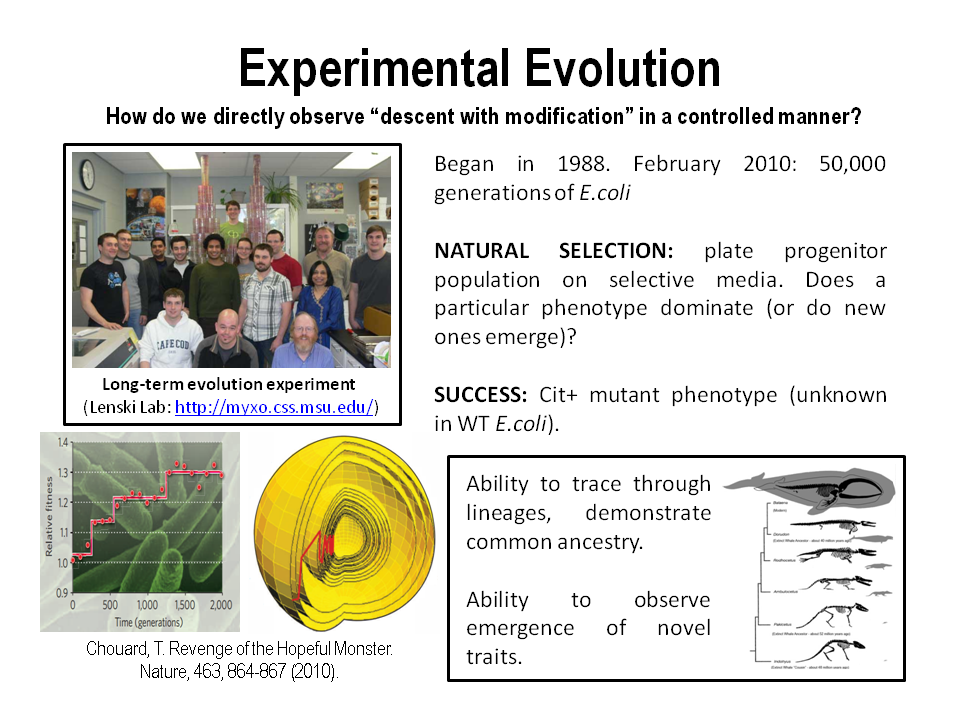
There were a number of talks on experimental evolution. There was an excellent conference on this topic held at the University of Michigan (ECSS 2010) in 2010. The slide below provides an overview of the Long-term Evolution Project run by Rich Lenski at Michigan State. Aside from paper and posters on that project, there was a presentation by Betul Kacar (Georgia Tech) on knocking in ancestral forms of key genes to create a "sub-optimal" bacterial phenotype. These populations would then evolve a means to compensate for this loss, which is experimentally tractable way to look at the evolvability of gene networks.


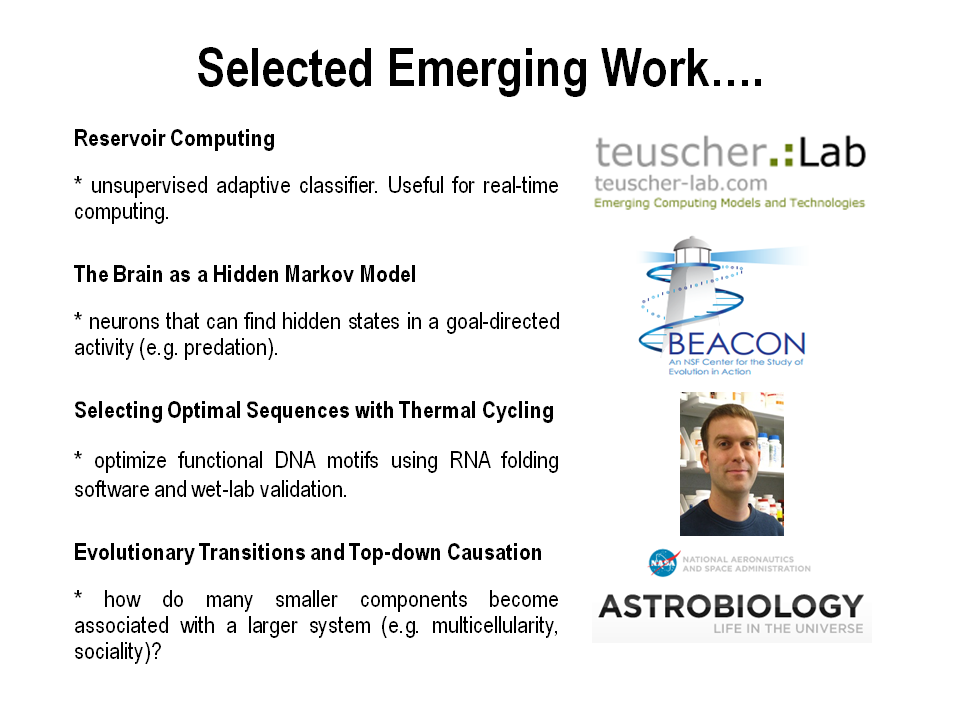
Below is a sampling of "emerging work" from the paper and poster talks. I chose these (see slide below) as they were the most intriguing to me. These four choices also demonstrate the broad diversity of topics covered.


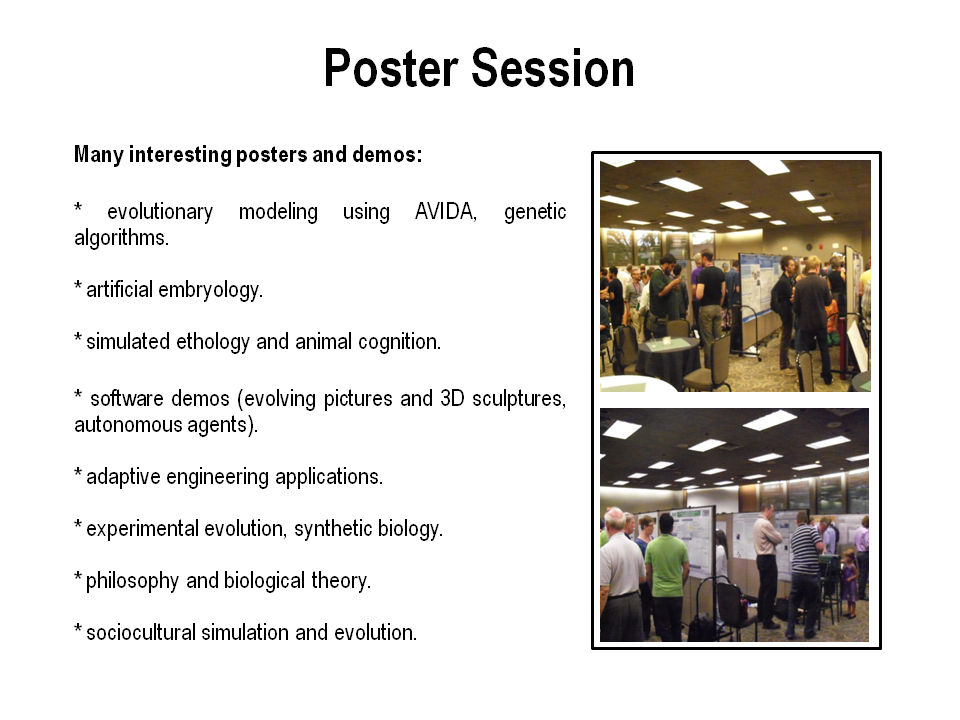
There were upwards of 50 posters presented in a single session. The range of topics are listed below. As an aside, there were many different type of layout used, ranging from traditional layouts (text, data, conclusions) to more avant-garde approaches (non-sequential images with minimal text).


That's all for this year (which turned out to be quite a lot). Looking forward to Artificial Life XIV, which will likely be held in Europe (as the location alternates between Europe and North America). And keep on evolving....

July 9, 2012

Alife XIII Proceedings: now available


The proceedings for Artificial Life XIII [1] are now available. This should include all papers being presented at the conference, in addition to the extended abstracts. A very good and diverse set of papers this year -- enjoy. By the way, my full paper contribution ("Contextual Geometric Structures: modeling the fundamental components of cultural behavior") is the first paper [2] under the Collective Dynamics track.


The program is also available. Nobel prize-winning physician Jack Szostak will be giving the Keynote address on Thursday, July 19 (7:30pm). Also found out that the talk for my paper will be part of Collective Dynamics session III (Networks and Topology) on Saturday the 21rst at 4pm.

Notes:
[1] The theme of Artificial Life XIII is "Evolution in Action".

[2] I believe the order is alphabetical and not of importance, but it still feels good to be the first paper. It's nice thing to have a last name that begins with "A" -- it can provide a short-term boost to the ego when needed.


October 19, 2011

Artificial Life XIII is coming

Artificial Life XIII will be held in East Lansing, MI from July 19-22, 2012. It will be hosted by the BEACON group, the NSF-funded evolution in action project also based at Michigan State.

Tracks include: evolution in action, behavior and intelligence, collective dynamics, synthetic biology, and art, music, and philosophy. The paper lineup should resemble previous Alife conferences [1, 2].

[1] Alife XII proceedings

[2] Alife XI proceedings

January 10, 2011

Is my research proposal bulls**t?

I try not to be too partisan on this blog, but the short version is this: elements of the new Republican Congress have attempted to "crowdsource" policy, and it seems to have redefined the term "know-nothings". Recently, Republican lawmakers used a crowdsourcing tool (YouCut Review) to nominate those NSF projects that were the biggest waste of government money.

The verdict: apparently, there weren't enough jeers to go around. Hence, the NSF must not be doing a very good job. Two stand out as project I've seen (excellent) presentations on:

Sound Physics in Virtual Worlds

Movement and information (Neuromechanics) in electric fish

And the outcome of said projects? Quite a bit of knowledge (e.g. research papers), and even a few very useful engineering artifacts. Hardly a "waste" of money. In fact, it's a bargain when you consider other things we waste money on:

Celebrity gossip (from what I've seen, the Paparazzi do more harm than good)

Lotteries (if the money spent here went to a tax increase, you'd be more likely to see a payoff)

Smear campaigns (politics - the 2010 election cycle in the US was burdened with around $4bn in attack ads, mostly by 3rd parties. It got to the point of being pure noise, at which point the parties in question kept on spending)

The point is that these NSF-funded projects were picked because they "sounded" like a waste of time, not because they actually are (my second list is probably closer to the truth, but they probably serve some valid social function). Please join me in outing this cynical strategy.

March 4, 2009

Dawkins talk, Michigan State University, 3/2/09

I attended the Richard Dawkins talk at MSU the other night. This was part of their WorldView lecture series. This was the first event in the series for which the Wharton Center was sold out (about 1200 or so seats). I have now attended lectures from four great minds in evolution: Richard Dawkins and E.O. Wilson (at Michigan State) and Ernst Mayr and Steven Jay Gould (at the University of Florida). Dawkins is good for
his combination of scientific and religious skepticism with evolutionary biology, which was in full form the other night.

The Dawkins talk was called "The Purpose of Purpose", and was a good general audience talk. I noticed how self-promoting the whole Dawkins enterprise was: his website looks like its part e-commerce website, part self-help guru website. This is a good model for aspiring intellectual brokers (e.g people who want to become rich and famous in exchange for 10 years of higher education). Anyways, the talk was about how not everything in the world around us has "purpose" (e.g. got there via a designer or is there for our utilization), and how things that look like they have purpose and things that DO have conscious purpose (such as art or human artifacts).


Our hosts for the evening. LEFT: Dr. Fred Dyer (MSU Zoology), RIGHT: Dr. Richard Dawkins (Oxford). COURTESY: Dr. Wesley Elsberry.

To accomplish this, he broke down purpose into two different types: archipurpose and neopurpose. Archipurpose involves things that are causal but not neccessarily purposeful (like a bird's wings or stars in the universe). When pre-scientific peoples looked up into the sky, they assumed that the stars were put there by God for our pleasure. They then built monuments and sacrified virgins accordingly. On the other hand, neopurpose is the direct byproduct of conscious intervention, and its products generally serve a definable purpose. This is not to be confused with the purpose of a bird's wing -- wings are there so that the bird can fly, but got there via natural selection rather than by a master
designer.

There were parts of the talk where he seemed a bit sluggish (perhaps it was just my imagination). The old Dawkins chestnut that our bodies are the vessels for our genes (and thus serve an archipurpose) was used as an example. while I understand what he is saying, I think that specific argument is a bit shortsighted. He also contrasted domesticated species, whose evolution is governed by neopurpose (artificial selection by human breeders) with wild, naturally-selected species. I thought this was an excellent way to drive this point home, and wished he had spent a bit more time exploring this theme. But overall, it was an outstanding talk.

Fred Dyer, the chair of our Zoology Department, fielded questions from the audience. At WorldView, questions are solicited from the audience and the moderator fields the best of the crop. This works well, since giving the mike to audience members in a first come, first serve fashion can lead to really bad questions. Dawkins revealed that he was not dogmatic about his atheism and skepticism: he would gladly change his mind in a heartbeat if he saw convincing scientific evidence of God. He also has no time for homeopathic medicine, which reminds me of a great quote from the Futurama episode "Crimes of the Hot":

Robot: Calling all scientists......

Human: I have a degree in homeopathic medicine!

Robot: You have a degree in boloney!

Dawkins is currently on a barnstorming tour across the USA. If you can catch one of his speaking engagements, I highly recommend it.

January 30, 2009

Dawkins on Campus!

If you happen to be in the Michigan State University area on March 2, Richard Dawkins will be speaking at the Wharton Center:

Relevant Info

The talk is sponsored by the WorldView speaker series and the EEBB (Ecology, Evolutionary Biology, and Behavior) program. Tickets are required, but are free to anyone with an MSU ID. I got my tickets last week, and the floor seating is sold out. This is the same lecture series that brought in E.O. Wilson last Spring.

Printfriendly